

















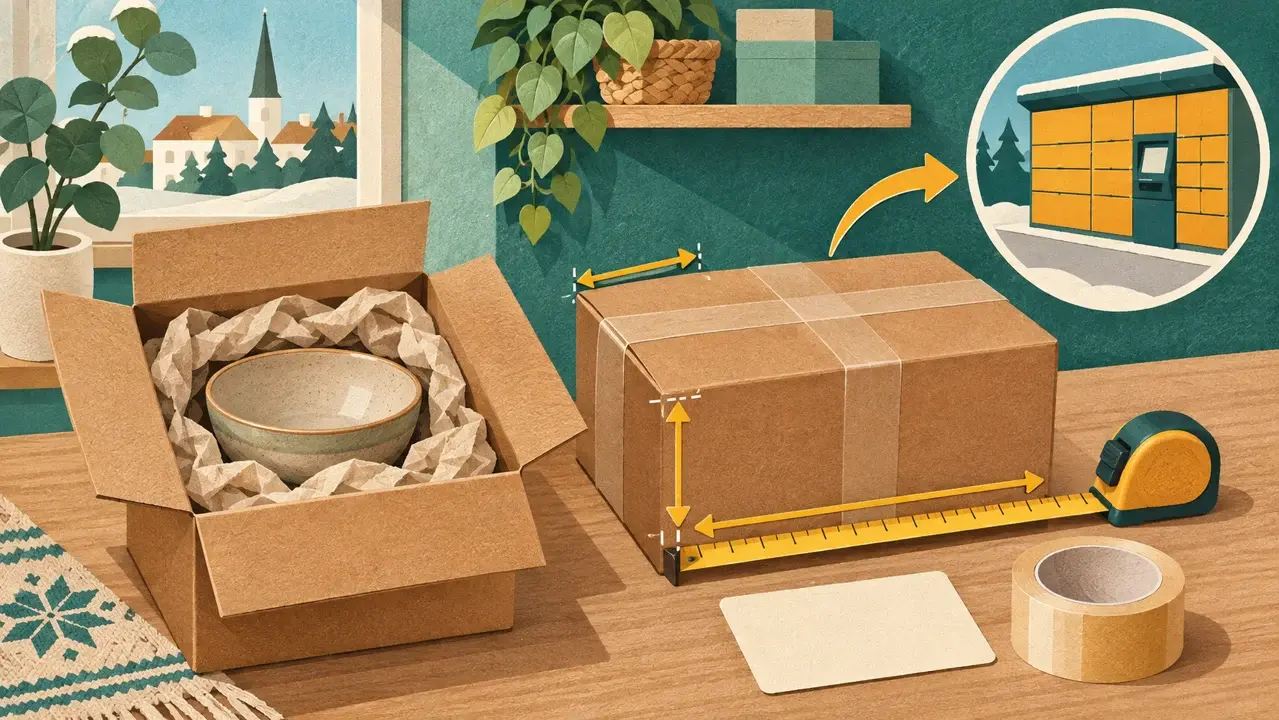
A seller agrees to send a small item in a small locker. Once the box is closed, it no longer fits. The avoidable mistake is choosing delivery from the product dimensions rather than the finished parcel. This guide starts after suitable protective packaging has been chosen: it is about measuring and booking, not how to cushion fragile objects.
Make one reliable measurement record
Put the closed parcel on a flat surface. Measure its three outside dimensions at the widest points, including any bulging lid or projecting packaging. Do not use the empty box’s printed dimensions without checking them: they may describe its inside space. Record centimetres and weigh the complete parcel with its contents, padding and tape. If your scale cannot give a reliable reading, arrange to weigh it before choosing a service.
A useful note contains the three measurements, the weight, the date and a photo of the closed package. Photograph a measurement so that both ends can be understood; a tape lying somewhere beside a box is not evidence of its length. Keep address labels and other personal details out of photographs shared publicly.
Compare three limits, not one size letter
Open the carrier’s current instructions for the exact route and service. Compare every side and the weight separately. A long, narrow parcel can have little volume yet exceed one side limit. A box that fits dimensionally can still be too heavy. Check minimum requirements too, particularly for small envelopes.
Do not transfer an S or M choice from one carrier to another. Omniva’s general size page and its keypad-locker page list different dimensions. Identify the actual locker type rather than assuming all units of one brand are identical. DPD also distinguishes weight limits by destination. A domestic choice should therefore not be copied into an international booking.
Leave room for handling, not just a mathematical fit
SmartPosti recommends a larger compartment when a parcel reaches the maximum permitted width and height, so the recipient can remove it more easily. Treat an uncertain measurement as a reason to check again, not to round down. Do not squeeze a box, remove needed protection or rely on diagonal placement to overcome a stated limit.
If an item must remain in a particular position, check whether the chosen service accepts that requirement. Turning a box around on a diagram is not a substitute for the carrier’s handling conditions. When safe packaging makes the parcel too large, compare another suitable service or collection in person.
Agree on delivery only after the check
Tell the buyer the finished dimensions and weight, the chosen carrier, the exact destination point and the total delivery charge shown for that booking. Avoid promising a universal price based only on “small parcel”. If you change the box or add another item, repeat the measurements before paying.
Before leaving home, compare the booking with your measurement record. DPD explicitly asks senders to check that the parcel matches the purchased size and service. If it does not fit at the locker, do not force it or leave it outside: follow the carrier’s instructions or contact support. Save the booking and handover confirmation. Correct dimensions help choose a service; they do not by themselves guarantee acceptance of every type of contents.