

















Buying a used suitcase: 7 checks before an autumn trip
Before an autumn weekend away or a longer holiday, inspect a used suitcase beyond its main photograph. A scratched surface may not bother you, but a sticking wheel or excessive exterior dimensions can make it unsuitable. Bring a tape measure and agree with the seller that you can test the mechanisms.
1. Start with your trip, not the words “cabin bag”
Consider whether you need the case for a flight, train or car journey and how far you will walk with it. Will you carry it upstairs, fit it into a small boot or roll it long distances? Check your storage space at home too. A seller’s “small” or “cabin size” description does not confirm suitability for your booking.
For flights, check the airline’s official, current baggage conditions for your journey and ticket. Write down the relevant requirements before the viewing. Do not rely solely on the seller having taken the case on another trip.
2. Measure the whole exterior and weigh it empty
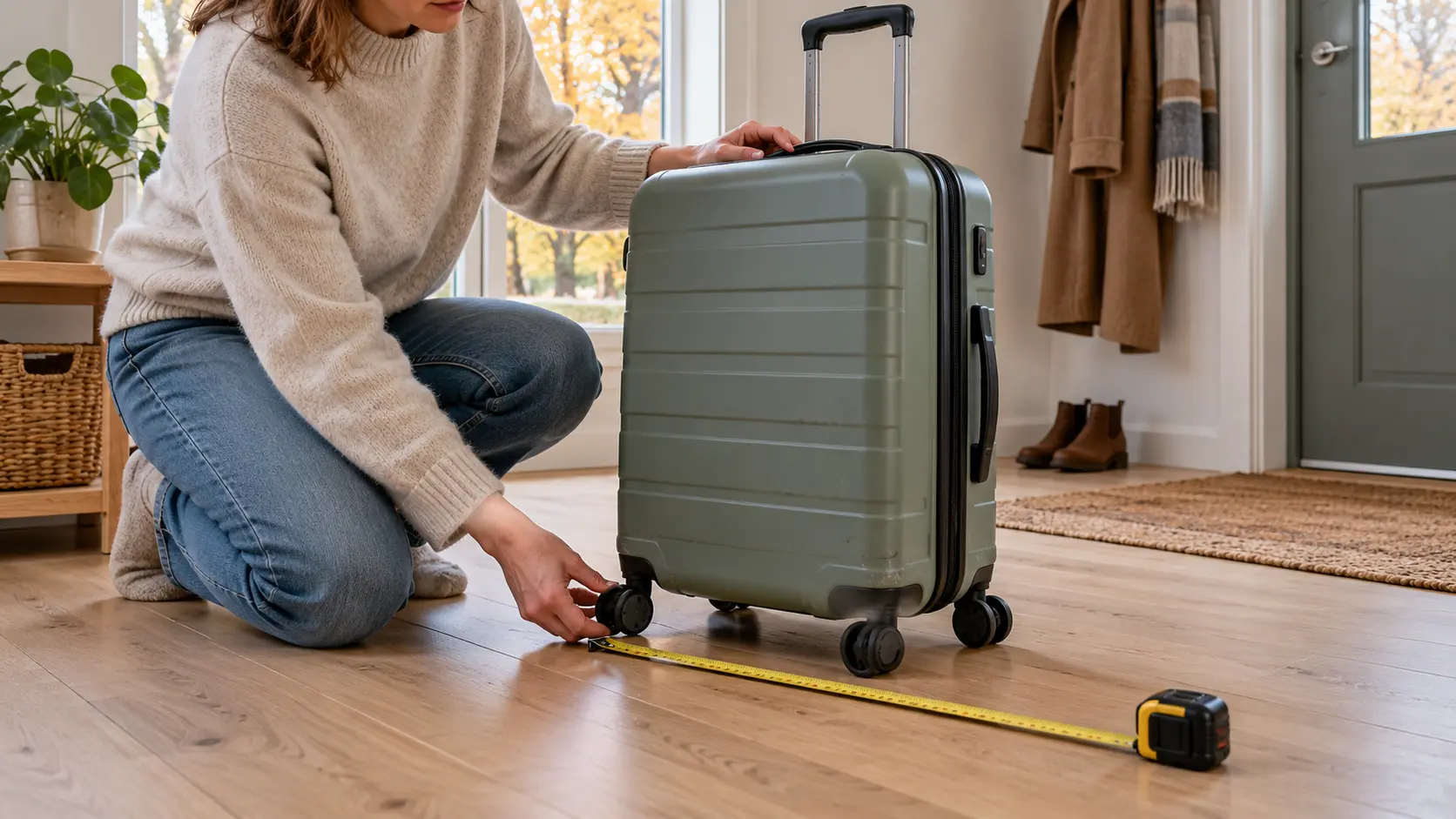
Measure height, width and depth between the outermost points. easyJet’s cabin-bag guidance includes handles and wheels in its measurements. Retract the telescopic handle, but include fixed protruding parts. Use a straight edge if needed rather than following curved surfaces with the tape.
Check the expansion zip and ask for measurements both closed and expanded. Pay attention to bulging external pockets on soft cases. Weigh the empty case and record the result. At home, try your usual packing, then measure and weigh it again before travelling.
3. Test every wheel and handle
Roll the case straight ahead on a level surface and turn both ways. Inspect each wheel mounting for looseness, sticking or damage. With permission, try a modest load within the manufacturer’s limit. A brief push while empty does not answer every practical question.
Extend and retract the telescopic handle several times. Check its intended locking positions and inspect the carrying-handle attachments. Do not force a jammed part. Treat an uncertain mechanism as an unresolved fault rather than assuming it only needs oil.
4. Open the closures and inspect the interior
Run each zip through its intended travel and examine teeth, stitching, corners and the expansion panel. Check the lining, pockets and retaining straps. Ask about repairs and previous storage; note strong smells, dampness or flaking components.
Ask the seller to demonstrate the combination lock and provide its instructions. Do not buy a case whose interior you cannot inspect or whose lock cannot be used normally. Remove personal luggage labels and old travel information before handover. Do not publish the lock combination in listing photographs.
5. Check the model and parts before buying
Samsonite’s product guidance identifies an interior label as one place to find the product ID. With permission, photograph the model details and damaged part. Samsonite’s spare-parts guidance uses that ID to locate suitable components. This illustrates model-specific checking, not guaranteed availability for every old case.
Confirm availability, total price and delivery time for the particular wheel, handle or lock before purchasing. Similar appearance does not confirm compatibility. If a workshop is needed, obtain a labour estimate too, and do not leave repairs until the day before departure.
6. Plan appropriate cleaning
Samsonite UK’s care guidance recommends a slightly damp cloth and mild soap for the exterior, followed by complete drying before storage. Follow your case manufacturer’s material-specific instructions. Do not assume an apparently removable lining is machine washable or that a strong smell will disappear.
7. Compare the total cost and record the agreement
Add transport, necessary cleaning, parts and labour to the price. Record included items, tested functions and known faults. As a seller, show exterior dimensions, the interior, every wheel and damage separately. Clear information helps a buyer decide before travelling to view the case.
- Do the dimensions and weight suit your journey?
- Have all wheels, handles and closures been tested?
- Are parts availability and repair costs known?
- Is there time for cleaning and a packing trial?