

















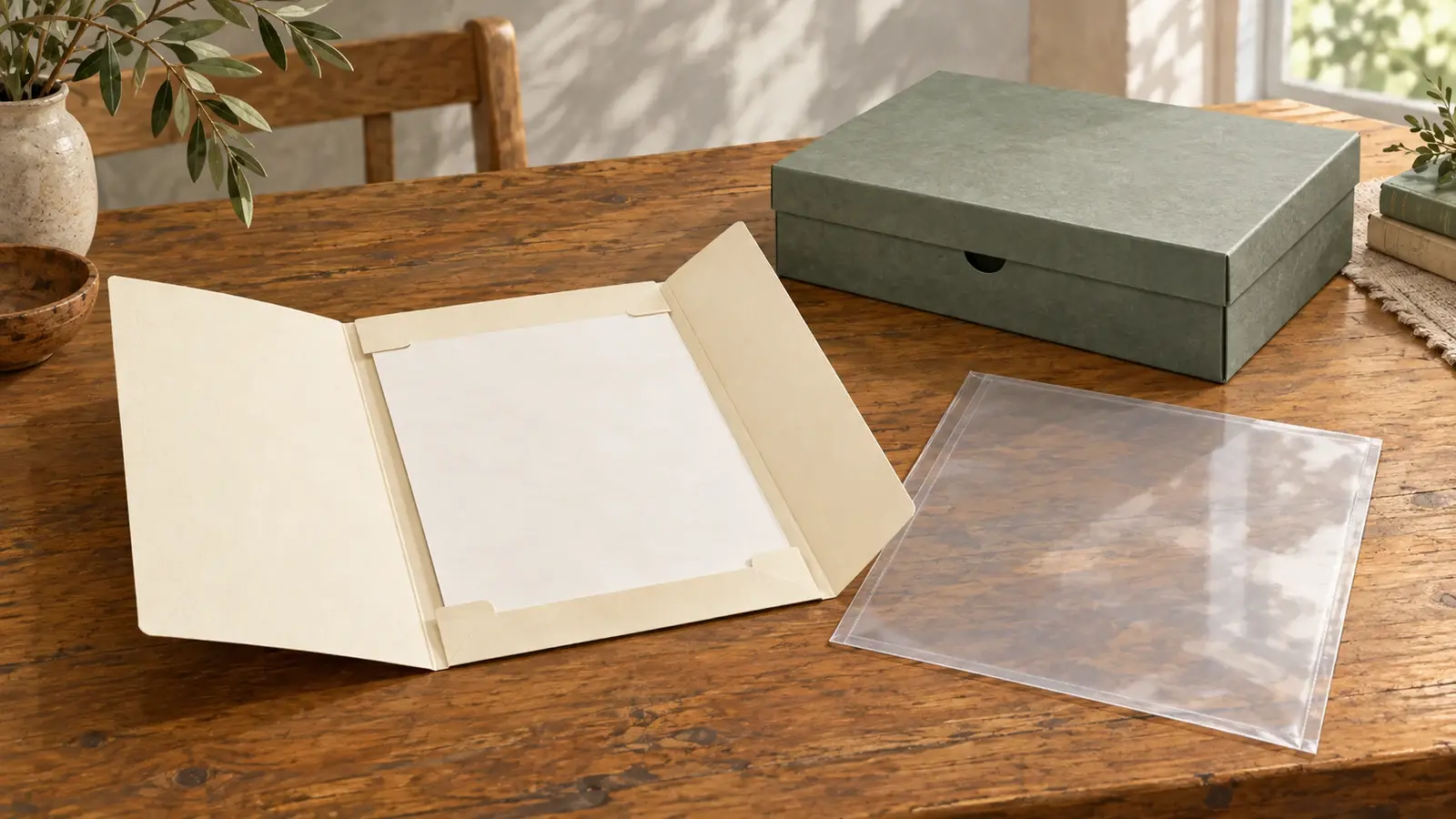
When organising family papers, a clear covering can seem an obvious choice. But a sleeve that allows a sheet to be removed and film bonded to it are different arrangements. Before buying a pack of sleeves or a second-hand folder, establish what you will store: working copies, ordinary notes or irreplaceable originals. One set need not suit them all.
Make a simple inventory first
Group papers into small, understandable sets without unnecessarily changing the order of connected sheets. Record the group names and largest document's dimensions. Note fragile sheets, flaking artwork and existing attached elements separately. Do not pull them off to make the collection look tidy. Where treatment is needed, choosing a folder does not replace advice from a paper-conservation specialist.
Establish the material, not a marketing word
The Library of Congress lists acid- and lignin-free folders as protective enclosures; clear polyester needs caution with powdery media.
Confirm the word “archival” in a listing against the particular product's specifications. Ask for packaging photographs and a product reference. If composition is unknown, colour or thickness does not establish suitability for long-term original storage. For an unusual medium, ask a specialist which enclosure is appropriate first.
Distinguish a pocket from bonded film
Establish whether the enclosure opens and allows removal without separating an adhesive layer. Do not test this with a valuable document: ask to see an empty example.
The Ford Conservation Center does not recommend lamination for preserving important paper originals.
If an item is already laminated, do not try heat or solvents to remove the film. Leave that intervention to a conservator and accurately record the existing condition meanwhile.
Check usable size and access
Measure the folder's and sleeve's internal space, not just the cover. The sheet should fit without trimming it to the chosen format. Plan how to retrieve one document without removing and rearranging the entire group. For frequently used information, prepare a working copy and keep its link to the original in the inventory. Do not punch holes in a family keepsake simply to fit an existing ring binder.
Inspect a used folder empty
Ask to see inner surfaces, folds and closure. Note moisture marks, sticky residue, dirt and damaged edges. Do not assume an unknown stain can certainly be removed. Establish whether the sale includes only the cover or internal pockets too, and which are new. For important originals, known material matters more than a large quantity of unidentified sleeves bundled together.
Before putting the papers away
- Originals and working copies are distinguished.
- Enclosure material is known and appropriate.
- A removable sleeve is not confused with adhesive lamination.
- Size is checked without trimming or new holes.
- Folder condition and included contents are described.
Label the outer folder and retain the inventory separately. Do not use the original as a test surface for adhesive or marking. Useful storage starts with clear, accessible placement, not an irreversible treatment merely to make a tidy stack.