

















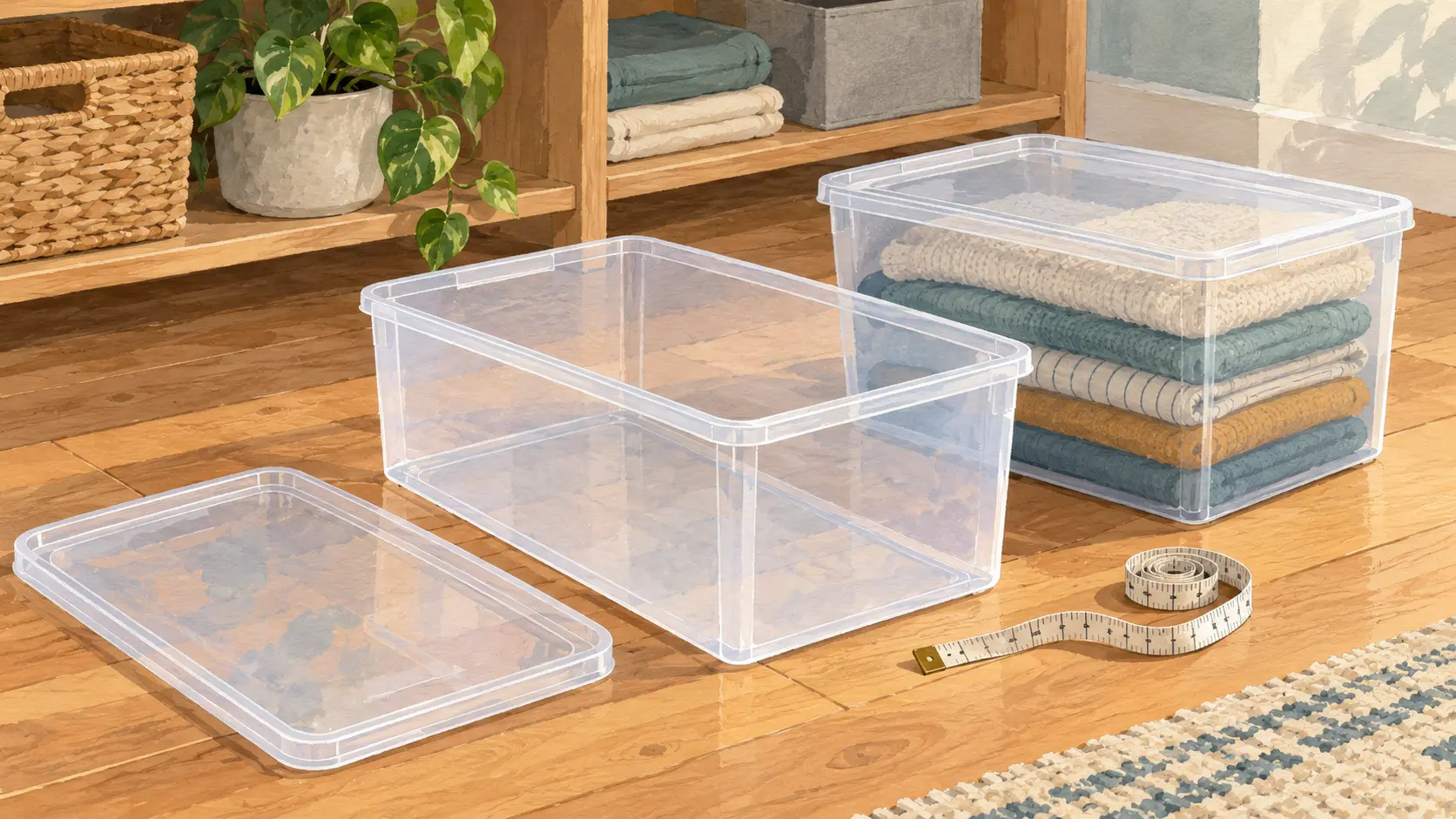
Putting summer equipment away often reveals a shortage of suitable containers. A bundle of used plastic boxes may help, but the number of litres is only the beginning. You need a container that fits the storage space, holds the actual objects and remains usable with its lid fitted. Start with the intended contents rather than the bargain bundle.
Measure outside and inside
Write down the shelf opening or space under the bed, including anything that obstructs pulling a box out. Measure the box with its lid and handles, not just the body. Leave room to remove it and open the lid without dragging it against another shelf.
For the contents, request internal measurements at the narrowest useful points, including the bottom. Tapered walls and rounded corners reduce the space for a rigid object. A capacity in litres does not describe the dimensions of an object that will fit, and it is not a permissible load in kilograms. If one item determines the purchase, compare that item's dimensions directly.
Pair every lid with its box
Ask the seller to lay out the complete bundle and identify which lid belongs to each container. Similar-looking boxes from different ranges or years need not share a lid. Check closures without forcing them; inspect all corners and whether the rim sits evenly.
Count missing clips separately. A replacement that looks close enough in a photograph is not confirmed compatible. Before paying for an incomplete box, find the correct part and its actual cost, or decide that the container will serve an open-storage purpose instead.
Inspect it empty
Look at the base, corners, handles and rim from inside and outside. Cracks, chipped edges, distorted lids or pronounced stress marks near a handle deserve more attention than superficial scratches. Do not prove strength by standing on the box, bending it sharply or loading it to failure.
Ask what was stored in it and where it was kept. A photo cannot establish odour or the history of chemical residues. If the previous contents are unknown, do not assume washing makes the container suitable for food or delicate personal belongings. Persistent odour or suspicious residue is a reason to choose another box.
Verify the intended environment
Check the exact product's instructions for indoor or outdoor use, food contact and cleaning. A clipped lid does not by itself prove waterproofness or suitability for a damp balcony. For example, IKEA's SAMLA 65-litre product information specifies indoor use and excludes food contact. That is a model-specific example, not a rule for every storage box.
Use the stated care method and allow the container to dry before packing dry belongings. Do not mix cleaning chemicals or test an unknown solvent on the seller's plastic. If essential use conditions remain unclear, choose a container with documented suitability.
Plan a stable arrangement
Find the maker's stacking and load instructions for the actual model. Matching outlines are not proof that two different boxes can safely support one another. Keep heavy contents low and avoid a tower that must be disturbed whenever you need the bottom box. Do not let children climb into boxes or close themselves inside.
Include the lid, any confirmed replacement parts, cleaning and collection in the total. A large cheap box that cannot be carried through the storage doorway may solve nothing. For a sale, show each empty box, its matched lid and the defects rather than only a tidy stacked bundle.
Ready to decide?
- Outside dimensions fit the space and removal route.
- Usable inside dimensions fit the intended objects.
- Lids and closures are present or a specific solution is confirmed.
- Condition and previous contents are understood.
- Intended use and stacking arrangements follow the product information.
Choose storage that works without relying on uncertain cleaning or an improvised pile. Fewer suitable boxes can be more useful than a mixed bundle you cannot organise safely.