















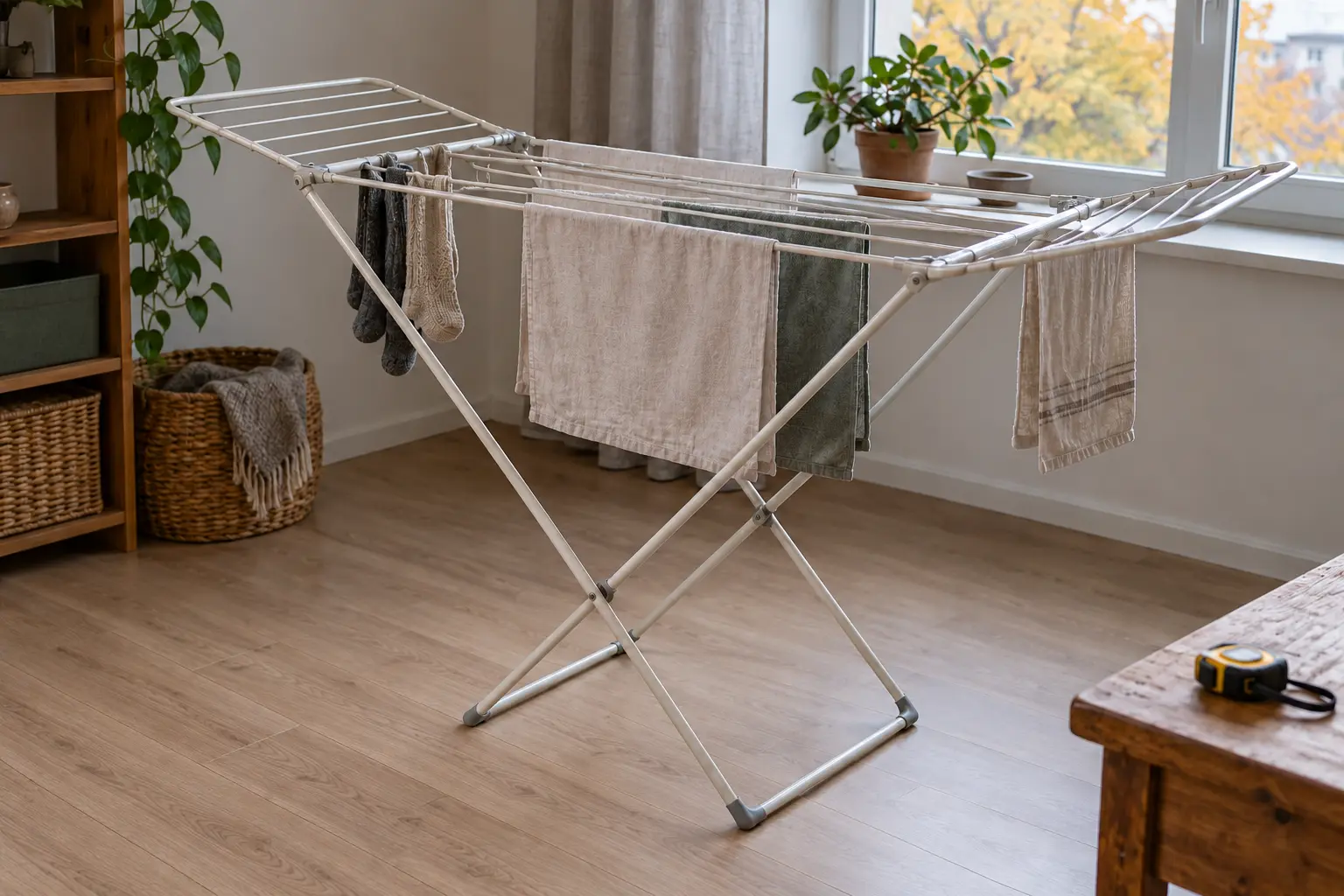
When autumn weather makes outdoor laundry less convenient in Estonia, a simple drying rack can earn its place indoors. Buying second-hand is worth considering if the frame is sound and the shape suits your home. The useful question is not merely how many metres of hanging space it offers, but whether your actual washing fits without turning the room into an obstacle course.
Measure the room before the rack
Mark out the intended position with a tape measure. Include the wings when extended, space to walk around the rack and room to open nearby doors or cupboards. A tall tower uses the floor differently from a low, winged rack. Neither is automatically better: choose for your usual laundry and the room where it will stand.
Measure storage space too. Ask for the folded height, width and thickness, not just the working dimensions. Check whether the folded frame can pass through the doorway or fit in the car. If it must slide beside a wardrobe, protruding feet and clips matter as much as the main frame.
Check useful space, not only the headline capacity
Think about your longest trousers, widest towels and the number of small items in a normal wash. Low rails may leave garments touching the floor; tightly spaced rails can make loading awkward. Take a clean, dry towel to the viewing, with the seller's agreement, and see how it hangs without piling everything together.
Manufacturers distinguish drying length from physical dimensions; the Leifheit product specification illustrates why both need checking. Do not translate a length in metres into a universal weight limit. Find the instructions for the exact model, including any load limit. Missing information is a reason for caution, not permission to test the frame with heavy weights.
Open, inspect and fold it yourself
Place the empty rack on a level, firm floor. Confirm that the legs open fully, supports engage as intended and every foot is present. Fold and reopen it slowly, keeping fingers away from moving joints. A reluctant hinge, loose rivet or cracked plastic bracket deserves a close look. Do not accept tape, bent wire or improvised screws as proof of a reliable repair.
Look along each rail and around its attachment points. Reject broken welds, sharp ends and a frame that will not stay properly open. Examine the underside, where damage is easy to miss in listing photos. With permission, wipe a small area using a clean damp cloth: transferred rust or flaking coating is a warning for clothes that will rest there.
Plan care and everyday use
Clean the rack according to its own instructions before the first wash goes on it. For example, IKEA's FROST care guidance specifies a soft damp cloth and mild detergent when needed. Avoid assuming that abrasives or strong chemicals suit an unknown coating.
Leave room between garments and follow their care labels; GINETEX explains the difference between hanging and flat drying symbols. A rack is not a substitute for the ventilation your home needs. Keep exits clear and follow heating-appliance clearance instructions. Never turn an ordinary rack into a heated dryer by covering a heater with it.
Agree the price and handover clearly
Compare the total cost, including collection and any genuinely available replacement feet, with a suitable alternative. A low price is not attractive if the rack cannot stand securely. Sellers should photograph the open and folded frame, joints, feet and any coating damage, then state measurements and missing parts plainly.
Keep the description and agreed condition in writing. TTJA distinguishes private sales from purchases from a trader; do not assume the same consumer protections apply.
Before you buy: a short checklist
- Open dimensions fit, with a clear walking route.
- Folded dimensions suit storage and transport.
- Rails suit your laundry, not just an advertised capacity.
- Joints, supports and feet are complete and undamaged.
- No sharp edges, loose coating or rust transfer is visible.
- Instructions, condition, price and collection are agreed.