

















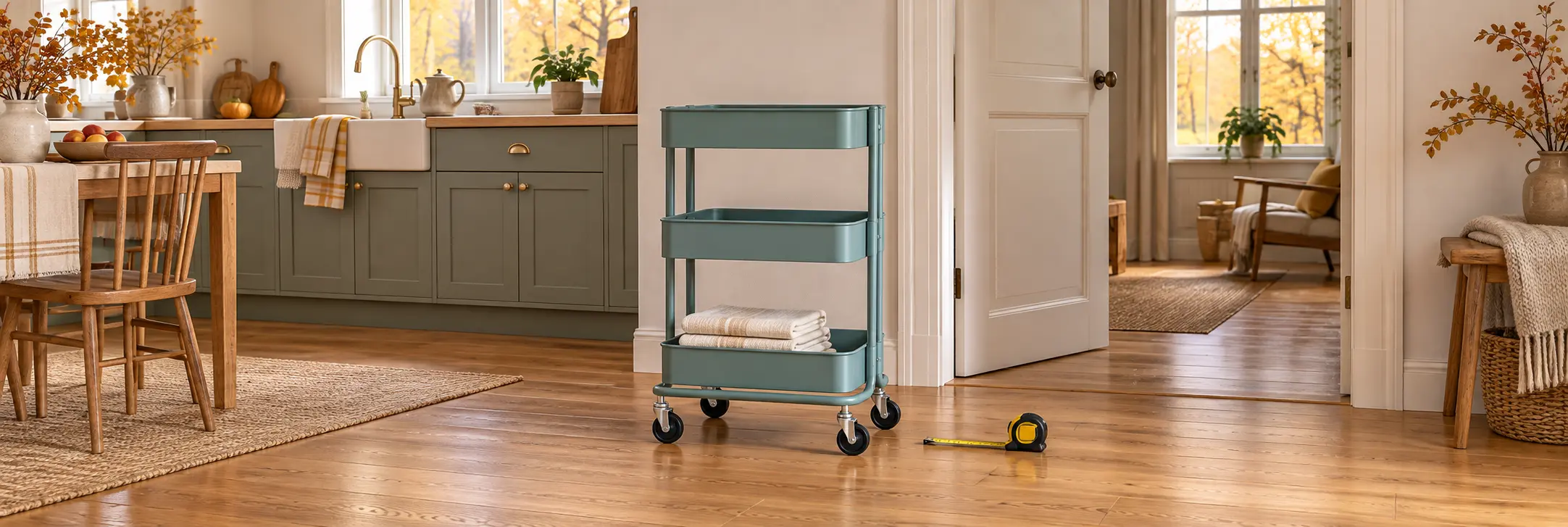
A small rolling cart can keep kitchen utensils or indoor hobby supplies close at hand during an autumn reorganisation. Its usefulness depends on more than fitting into a photograph. Before buying second-hand, check where it will stand, how it will move and whether the actual unit is complete and sound.
Measure the parking space and the journey
Measure the available gap at floor level, allowing for skirting boards, handles and neighbouring furniture. Open nearby doors and drawers. A cart that fits when everything is closed may become an obstruction during ordinary use.
Then walk its route to the place where you need it. Note narrow turns, rugs and thresholds. Ask for the widest assembled dimensions, not the carton dimensions, and allow room to hold and steer it. Do not assume small wheels will cross your threshold comfortably.
Measure the usable shelf space
Overall height does not tell you whether a tall bottle, craft container or stack of materials fits between shelves. Ask for the opening above each shelf and the usable area inside raised edges. Include any added handle or top in the overall measurement.
Decide what will actually go on the cart before choosing it. A neat collection of lightweight supplies and a heavy toolbox are different loads. If the intended contents are unclear, postpone the purchase rather than trying to justify the capacity afterwards.
Find the exact model and load limits
For example, IKEA Estonia lists RÅSKOG article 405.821.81 at 35 × 45 × 77 cm, with 6 kg per tier and 18 kg overall. Check that model’s specification.
IKEA’s NISSAFORS article 203.997.77 has a different footprint, 50.5 × 30 × 83 cm, and a 7 kg shelf limit. See its separate instructions.
These are examples, not limits for every cart with a similar name or appearance. Check the label and matching manual. Respect both shelf and total limits, and remember that a manufacturer’s rating does not certify the condition of a damaged used item.
Try each wheel and any fitted brakes
On a level surface, roll the empty cart gently forwards, backwards and through a turn. Watch for a dragging wheel, loose attachment or rocking frame. If brakes are fitted, test each one; do not assume every version has them.
Inspect wheel mountings, fasteners, shelf corners and joints. Missing hardware, a cracked joint or obvious structural distortion is a reason to pause. Do not test strength by overloading, standing or sitting on the cart. A brake is not protection against tipping.
Match the cart to its surroundings
Check the manufacturer’s permitted environment and cleaning instructions. Do not assume a domestic cart is suitable for a damp workshop, outdoor storage or food preparation. Keep food in suitable containers rather than treating a painted shelf as a chopping surface.
Look underneath for corrosion and around shelf edges for damage. A fresh-looking top can hide trouble below. Do not plan heavy machinery or a leaning work surface on a light domestic storage cart.
Plan collection and write a useful listing
Check whether it fits your transport assembled. If dismantling is necessary, agree which parts, wheels and fasteners must travel together, and obtain the correct assembly instructions.
For a sale, photograph the label, every wheel and the shelf surfaces. State dimensions, known faults and whether fitted brakes work. The final checklist is simple: parking space, route, shelf openings, documented limits, sound structure and complete hardware. If one is unresolved, a low price does not resolve it.