

















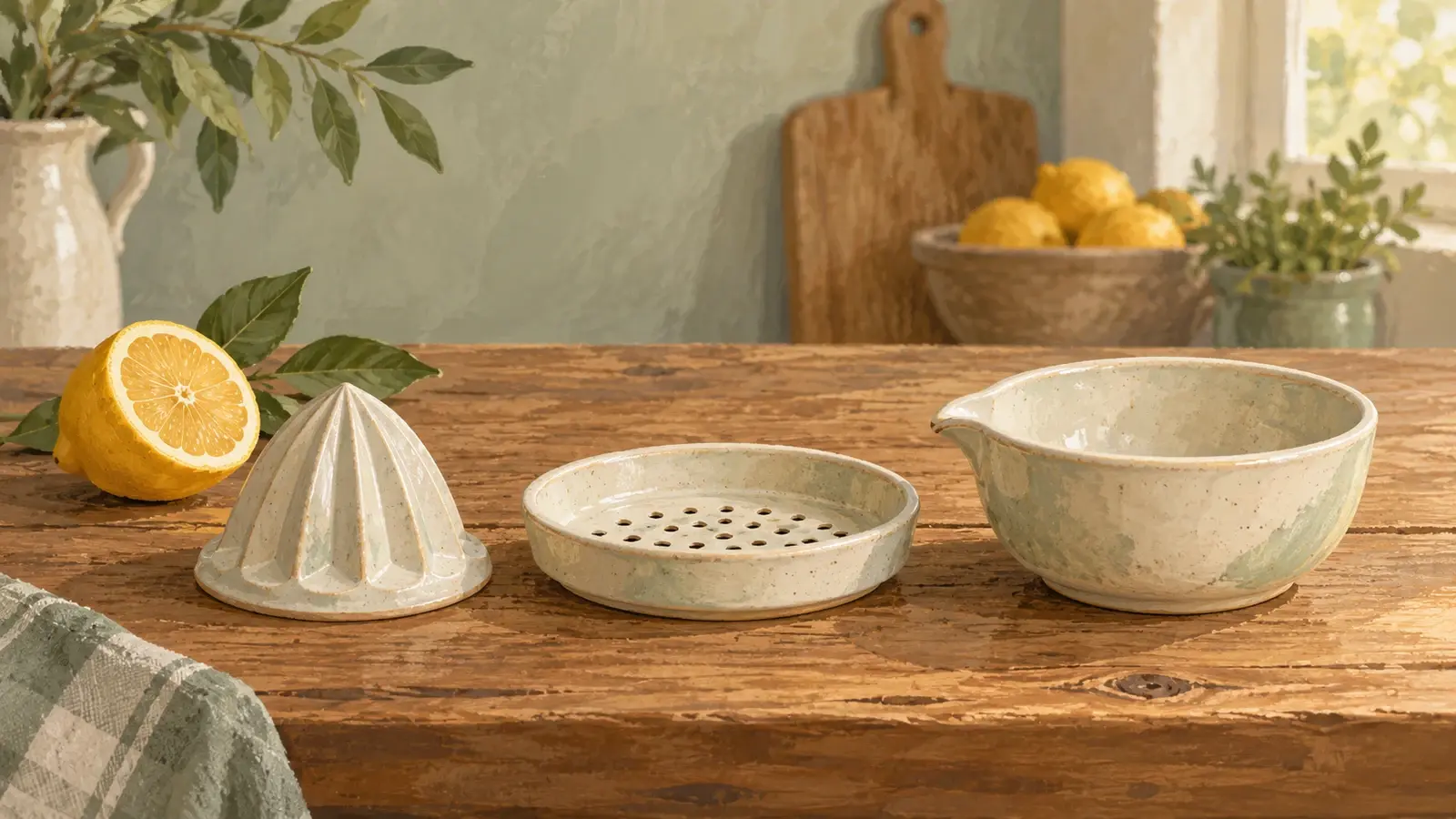
A small manual citrus juicer can look complete while a second reamer is missing or the strainer belongs to another model. Before buying second-hand, ask to see the parts laid out. The useful question is not how hard someone presses or how much juice appears in a photograph, but whether the construction is identifiable and straightforward to inspect.
Establish what is being sold
Find the manufacturer and model. This checklist concerns small, non-electric juicers with a reamer, strainer and collecting vessel. Lever presses and powered appliances need different checks. Do not transfer their dismantling instructions from a similar-looking kitchen accessory.
Request a photograph of the assembled item and another showing the parts removed as instructed. Compare them with the original set description. If the seller does not know where an attachment came from, leave compatibility unresolved rather than treating a matching colour as proof.
Inspect connections and working surfaces
Look at the reamer ridges, strainer rim, seating surfaces and pouring spout. Note cracks, chips, distortion and damaged coatings separately. Do not promise that an unidentified deposit will necessarily wash away. Nor should you trim plastic or press harder to make parts fit.
Ask to see the empty set assembled gently. Parts should go together as intended without a hand concealing or supporting a crack. If an attachment is stuck, find the manufacturer's guidance before pulling at it. An inspection should not create a new defect.
Match the set to your task
Consider the citrus fruit you normally use and where you will pour the juice. Check whether the empty vessel is comfortable to hold, whether its markings remain readable and whether it fits your storage space. Markings alone do not demonstrate measurement accuracy.
For example, OXO's 2-in-1 Citrus Juicer has two removable reamers and a dishwasher-safe designation. OXO: 2-in-1 Citrus Juicer
Those are details of that model, not promises about every similar object. In a used set, check separately that both intended attachments are actually present. A part shown on a new product page is not automatically included in the seller's offer.
Choose care for the complete set
Before cleaning, read the guidance for the exact model and its removable components. Do not infer permissible heat from plastic colour or transparency. If identification has worn away, seek manufacturer confirmation instead of guessing a dishwasher programme.
Inspect the item after permitted cleaning and drying. Show remaining marks close up in ordinary light. “Washed” describes an action; it does not establish that the object is undamaged or that an unidentified material is suitable.
Before handover
- Name the model and list the actual parts.
- Show reamers, strainer, vessel and connections.
- Disclose damage and parts of uncertain origin.
- Keep the appropriate care instructions.
- Pack small attachments so they cannot disappear.
Choose a simple kitchen tool as a complete, identifiable set. If an essential part is unknown or damaged, resolve that before buying rather than expecting a thorough wash to settle the question.