


















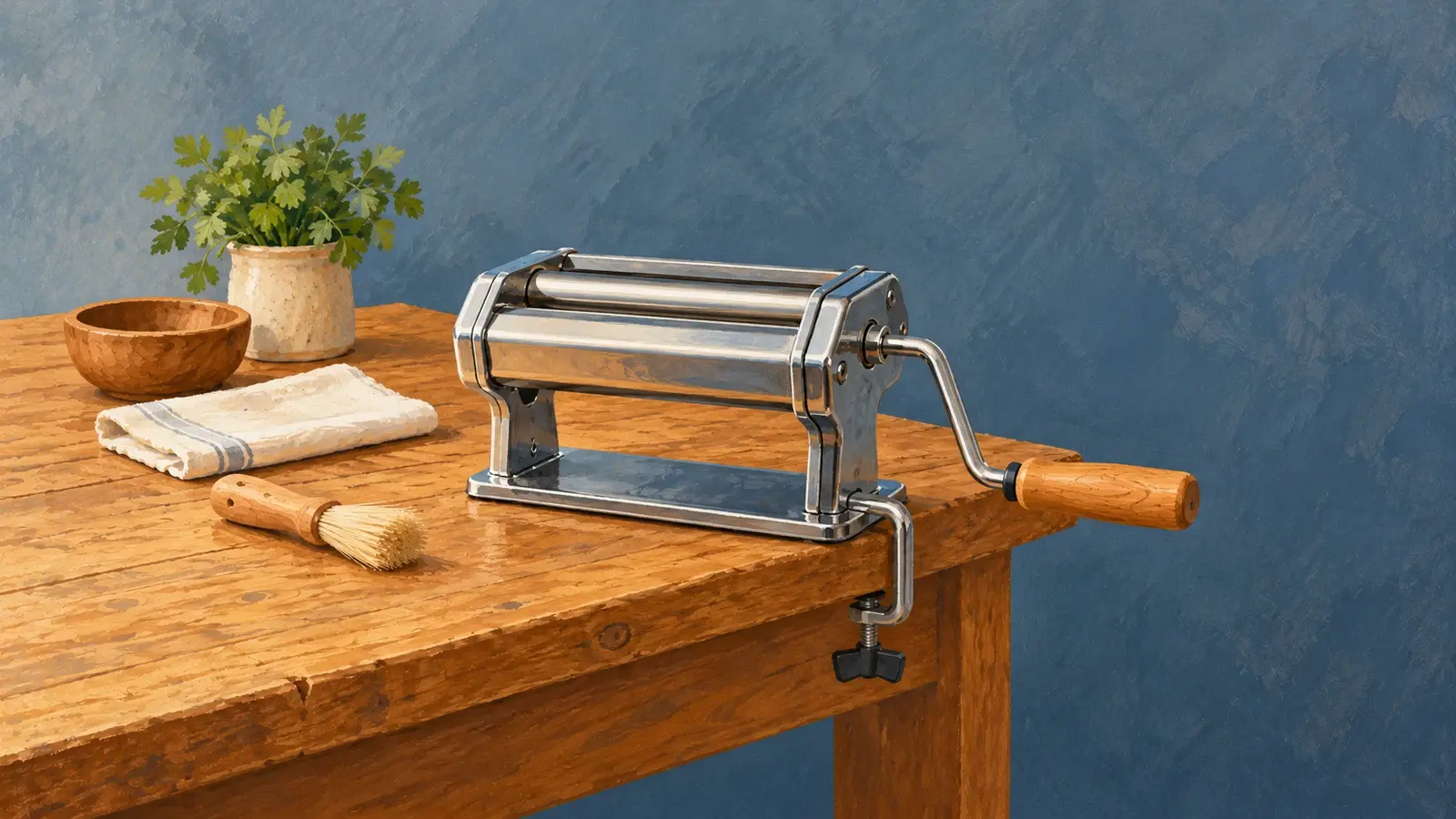
Manual pasta machines are often photographed sitting alone on a table. That makes a missing clamp or crank easy to overlook. Before buying, picture your actual workspace rather than an attractive kitchen scene: where will the machine attach, where will the handle turn, and how will you prepare it after someone else's storage? These questions matter more than the attachment count in the headline.
Identify the exact model
Ask for a photograph of the model marking and every side of the body. Match it to the manufacturer's manual. Do not copy assembly instructions from a similar machine: appearance does not establish whether fittings and removable parts are the same. Record whether the sale includes only the roller or a cutting attachment as well. If identification remains uncertain, do not build a maintenance plan around the first online video you find.
Check your table edge
Measure the worktop thickness where you intend to use the machine. Look underneath: a rail, drawer or projection may obstruct the clamp even when there is plenty of space above. Ask about the opening of the actual clamp supplied and compare it with the instructions. Allow room for the crank to turn and the dough to emerge. Do not plan to replace the proper fitting with a random clamp unless the manufacturer permits that arrangement.
Lay out the whole set
Ask to see the body, crank, clamp and each attachment as separate items. Identify part numbers and compatibility for extras. An unsupported claim that a part “fits everything” is not enough. If something essential is missing, establish a suitable replacement and check its availability and cost first. Only then can you distinguish a usable set from an unfinished collection of parts.
Ask about previous use
Was the machine used only for food dough, or also for craft materials? Record the seller's answer as a statement, not as a verified fact. Without dismantling anything, inspect accessible surfaces and rollers for visible damage, corrosion or unknown residue. Do not assume every problem can be washed away. If the history or contamination remains doubtful, postpone buying it for kitchen use rather than planning an improvised restoration.
Care starts with the manual
Marcato prohibits washing the machine under a tap or in a dishwasher; removable combs and scrapers have separate instructions.
This illustrates why model identification matters, not a universal cleaning recipe. Do not dismantle unfamiliar mechanisms for the sale or choose an arbitrary solvent. If the seller demonstrates operation, the machine should be secured and used according to its manual, with fingers and unrelated objects kept away from the rollers.
Before deciding
- The model and manual are identified.
- The clamp suits the intended workspace.
- The crank and required attachments are listed.
- Previous use and unresolved questions are recorded.
- Visible defects are shown and the care method is understood.
Photograph the set exactly as it will be handed over and plan somewhere to keep its small parts. A short demonstration does not establish internal cleanliness or remaining service life. If an essential replacement is still only a possibility, settle that question before the meeting, not after the purchase.