


















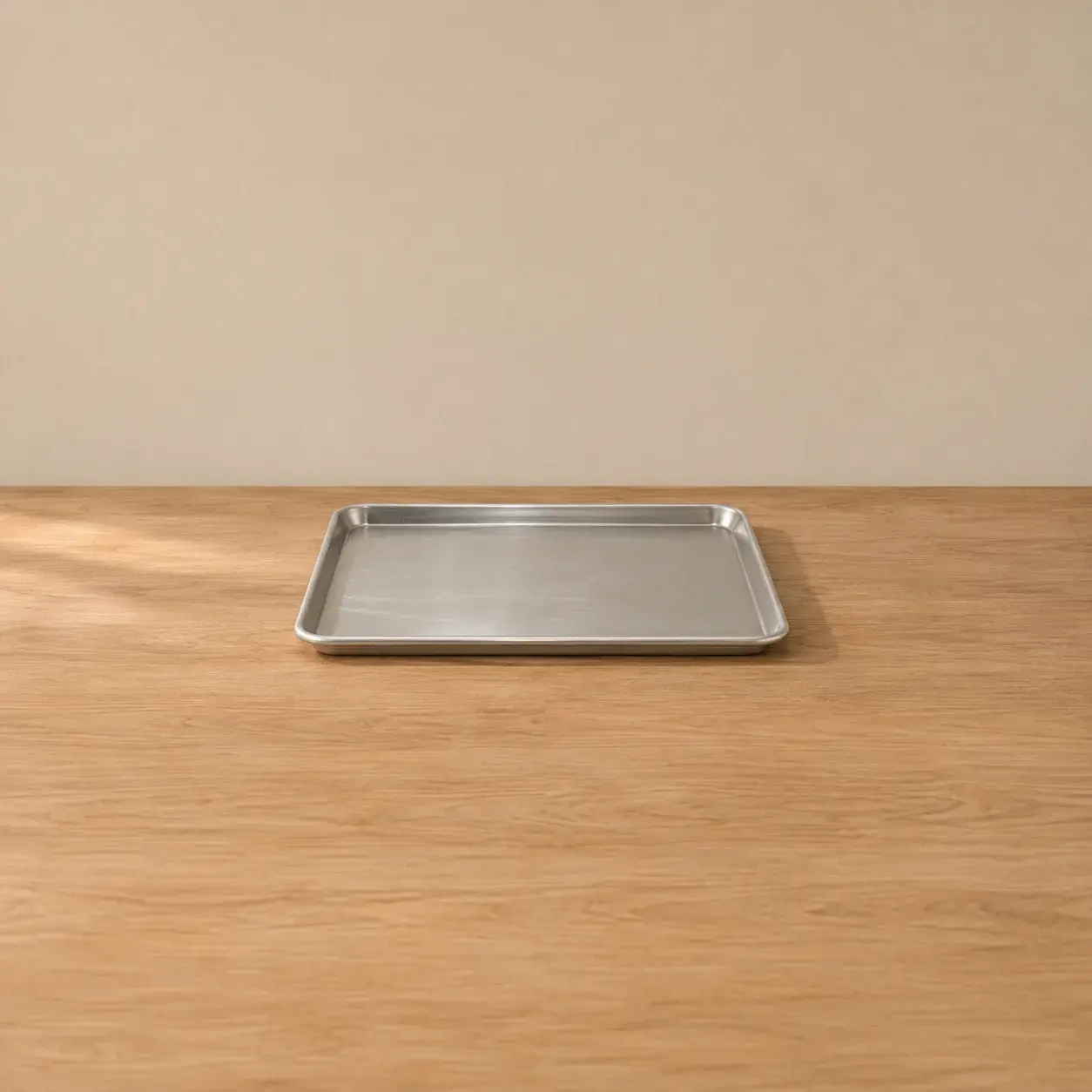
A tray advertised as “for a 60-centimetre oven” may still be the wrong replacement for your appliance. That description does not tell you whether the tray rests on a wire shelf or slides directly into the oven's side supports. Before buying second-hand, establish its intended support method and measure the whole rim, not just the flat baking area.
Separate three different measurements
Ask for the maximum outside width and depth, including rolled edges, lips and handles. Then ask for the usable flat base and the height of the sides. A ruler photographed across the middle may show the cooking surface while missing the parts that determine whether the tray fits through the door or onto its supports.
Nordic Ware's dimensional drawing for its Naturals Baker's Half Sheet gives separate outer and inner measurements. It is a useful example of why “half sheet” or a rounded size is not enough. Record which dimension is measured from side to side and which runs from front to back, so you do not compare a tray's depth with an oven's width.
Decide what will support the tray
An ordinary baking sheet intended to sit on a wire shelf should be checked against that shelf and the oven instructions. A replacement tray designed to engage directly with side rails needs confirmation for the exact appliance. Width alone does not describe the shape of its supporting edges, stops or relationship with telescopic runners.
Bosch's official accessory page provides a compatibility check using the oven's model number, alongside the tray dimensions. Find your model on the appliance rating plate and use the manufacturer's information where available. Do not assume that another oven from the same brand takes the same accessories.
- Ask the seller for the tray's part number and the oven model it came from.
- Compare photographs of the side edges and underside, not only the top surface.
- Check any installation direction or required accessory in your oven's instructions.
Inspect the actual used tray
Look for distorted rims, pronounced twisting, sharp damage and flaking coating. Ask for a side view on a flat surface as well as close photographs of the corners. Staining and structural damage are different observations; describe what is visible without promising that every mark will wash away. Do not conceal uncertainty beneath baking paper.
If compatibility is confirmed and a trial is possible, check the empty tray in a completely cool, switched-off oven. It should use the intended supports without force or improvised spacers. Do not bend the rim to make it fit. A cold fit does not replace the manufacturer's temperature and use limits.
In a listing, include outside dimensions, base dimensions, side height, identification and any known damage. Those details make a useful replacement much easier to distinguish from a tray that merely looks similar.