
















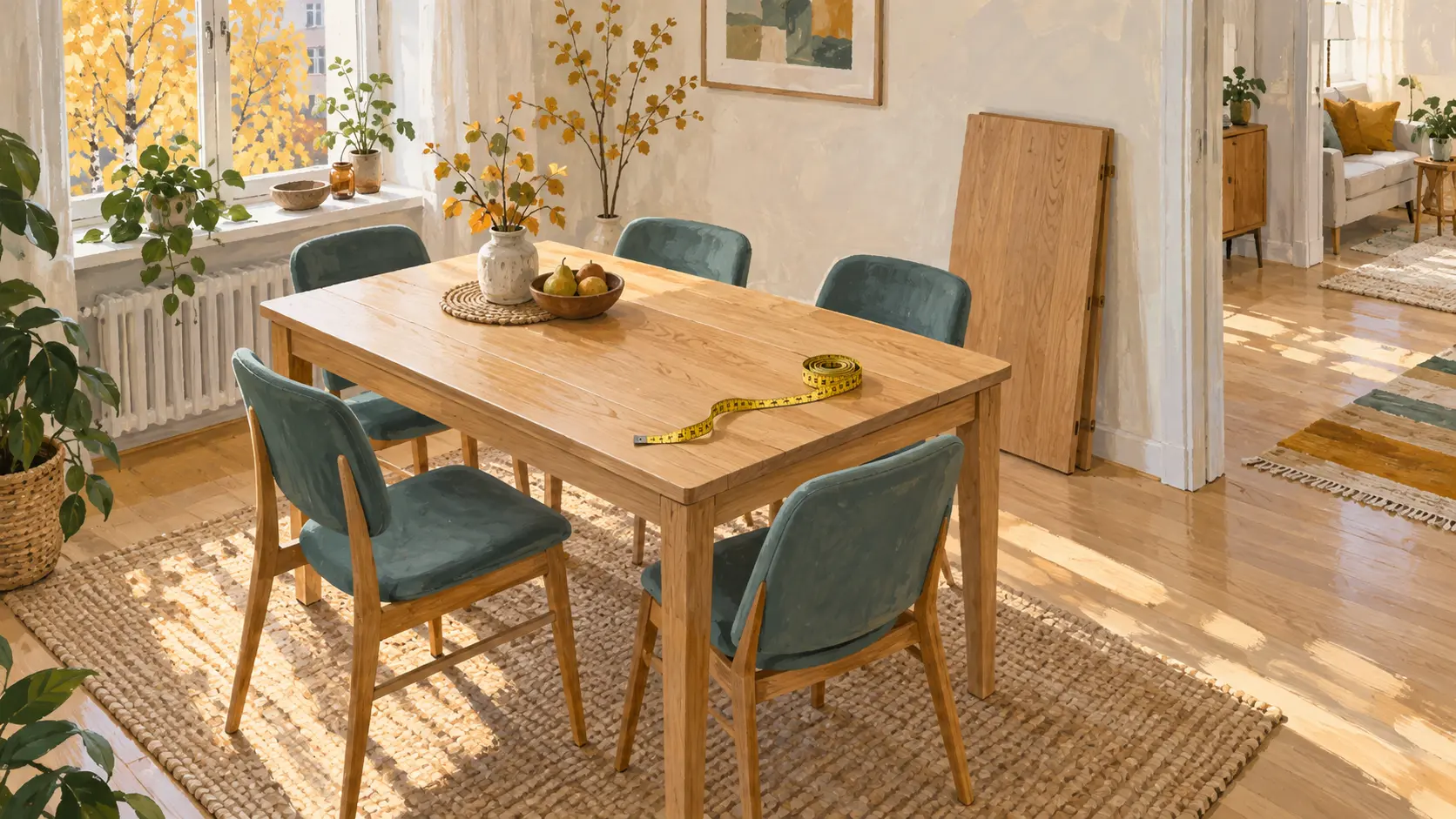
An extending table can suit everyday meals and occasional visitors, but the room has to work in both arrangements. A photograph of the closed table cannot answer that question. Before contacting a seller, make two simple plans at home. This turns “it should fit” into a decision based on your actual chairs, doors and daily movements.
Plan A: the ordinary day
Write down the table’s closed length, width and height. Mark its outline with paper or removable markers suitable for your floor; do not risk a finish with untested adhesive. Add the chairs you normally use rather than imaginary narrow seats. Think about other tasks at the table, such as homework or sewing. The first plan should work without moving furniture every time someone wants to sit down or open a nearby cupboard.
Plan B: the full extension
Ask for the dimensions with every extension you intend to use. Mark this second outline differently and note which end or side moves. Put the extra chairs into the plan and check their storage place when they are not needed. Also find a home for separate extension leaves. An unverified promise that they “fit underneath” is not enough; ask the seller to show the intended storage arrangement and check the model’s instructions.
Use a real chair to test the route
IKEA’s planning advice accounts for chairs and movement around a table, not just its top. At home, sit down, move the chair back normally and ask someone to pass behind where needed. Try the adjacent cabinet and room doors. A tight gap on paper may be uncomfortable in practice, especially with wider chairs or a household member’s mobility needs. Keep the usual route through the room usable rather than planning only for empty chairs pushed in.
Ask to see the complete mechanism
At the viewing, ask the seller to demonstrate opening and closing according to the exact instructions. Look underneath and identify the leaves, supports, rails and any locks the design uses. Different tables work differently; IKEA’s NORDVIKEN drop-leaf model is one example with a locking leaf. Do not assume that your table uses the same mechanism. Missing fittings, a jammed rail or a leaf that needs force should be resolved before purchase, not improvised away during the demonstration.
Decide with both plans in front of you
Record two separate results: everyday arrangement and visitor arrangement. If only the first works, the table may be unsuitable for your intended gathering even though its closed dimensions are perfect. If both fit but the extension is incomplete, establish the correct replacement part and cost before counting on it. Finally, measure the route into your home and confirm any permitted disassembly. A room plan does not prove that the assembled table can pass through the entrance.
The measurements to keep together
- Closed and extended length, width and height.
- Space under the frame for your actual chairs.
- Which parts move and where loose leaves are stored.
- Required fittings and the instructions for that version.
- The carrying route and any authorised disassembly.
In a Zeppik listing, show both arrangements and the underside, with dimensions attached to the correct photograph. Avoid promising a fixed number of comfortable seats from tabletop length alone. A smaller table that passes both home tests can be more useful than a larger bargain that blocks the room whenever it is extended.