


















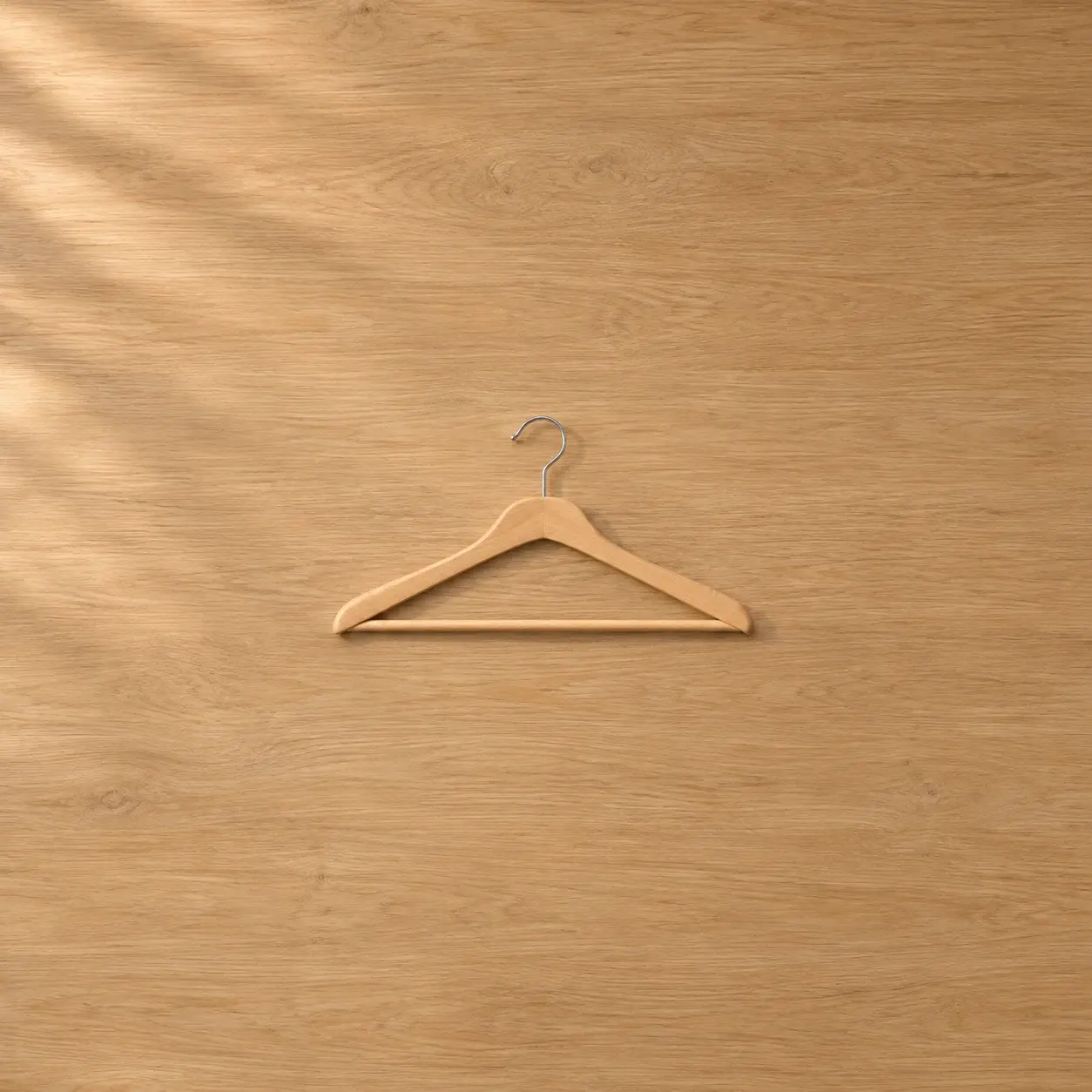
A bundle of matching hangers looks like an easy purchase until the wardrobe door presses against every jacket. Before collecting a second-hand set, check two things separately: whether the shoulders suit your clothes and whether the loaded hanger fits inside your cupboard. A photograph of a tidy bundle cannot answer either question.
Measure the hanger across its widest points
Ask the seller for a straight measurement from one outer shoulder tip to the other, with the tape visible in the photograph. Do not measure along the sloping upper edge. For a mixed bundle, request the smallest and largest widths rather than one representative measurement. IKEA lists its BUMERANG hanger at 43 cm wide; that is one model specification, not a universal adult size.
Compare the offered hanger with one that already supports a particular shirt or jacket well. Put the two together and inspect the shoulder slope, curved ends and thickness as well as the span. A narrow, flat hanger and a broad coat hanger can share the same overall width while occupying different amounts of space along the rail.
Check depth where the clothes actually hang
With a conventional rail running from side to side, the hanger extends towards the back and door. Measure the available space at shoulder height, from the inner back to the nearest obstruction towards the closed door. Include hinges, sliding-door parts and anything projecting into that area. Then check the rail position: enough total depth does not help if one shoulder sits too close to the back.
IKEA's PAX planning guide lists frame depths of 35 and 58 cm. Those figures describe frames, not your cupboard's usable clearance. If the rail runs front to back instead, check the hanger across the cupboard's internal width. Follow the actual hanging direction rather than assuming all wardrobes work alike.
Inspect the bundle before paying
- Count usable hangers by size and shape. Matching colour does not guarantee matching dimensions.
- Check wooden shoulders and trouser bars for splits, loose joints and sharp edges. Look for cracks or distortion in plastic.
- Inspect hooks for rust and insecure attachment. A hook designed to rotate should not be confused with one pulling loose.
- Try one hanger with the intended garment and close the door gently. Stop if the shoulder or fabric catches.
Do not force the door shut to prove a fit, or rely on turning every hanger diagonally. Ask to buy a small suitable group if the bundle is mixed. A useful listing on Zeppik shows the measured span, hook shape, quantity by type and close photographs of defects, making the collection decision much easier.