


















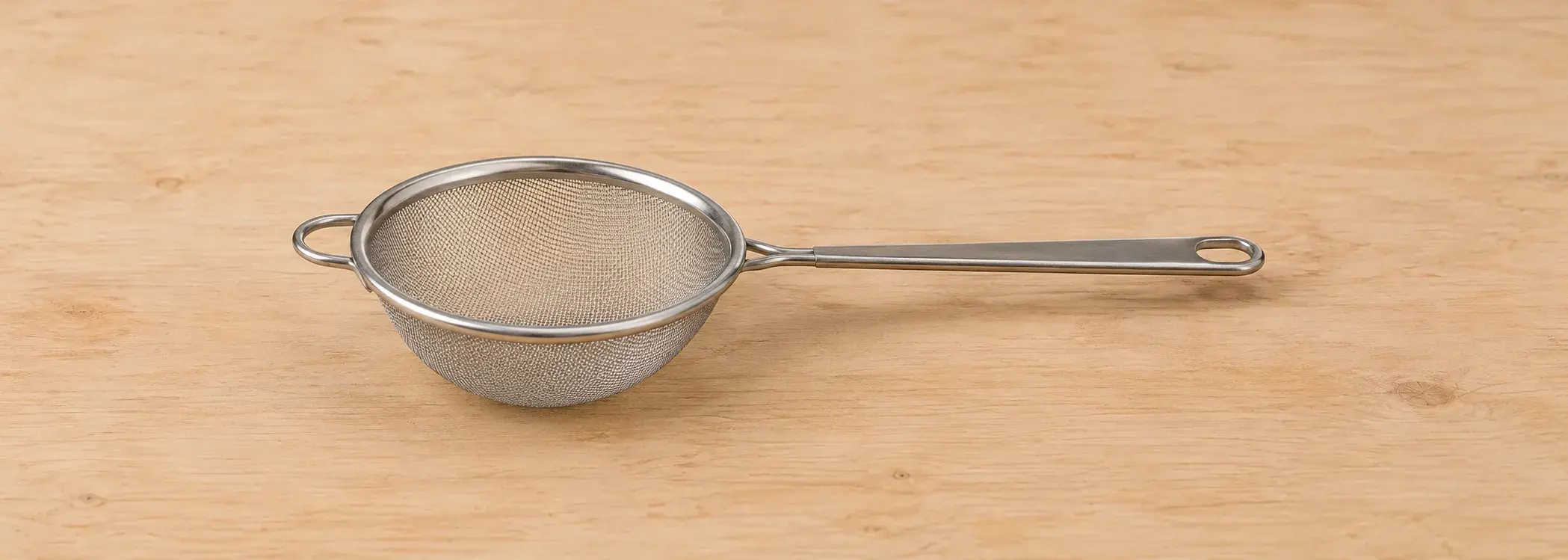
A kitchen sieve is easy to underestimate when buying second-hand. A shiny rim and tidy handle tell you little about the mesh underneath. Before choosing one for rinsing berries or straining a sauce, decide what you actually need to separate. A mesh that suits one job may let smaller ingredients through, and a photograph cannot establish its precise fineness.
Start with the working surface
Ask for a clear photograph from above, another from underneath and a close view where the mesh meets the rim. Look across the whole basket in good light. Openings should not suddenly become larger around a dent, and no wire should project from an edge. Do not run a fingertip across the mesh to search for sharp ends.
A shallow dent is not the same defect as a tear, but both deserve a closer look. Check whether the mesh has pulled away from its surround. If a seller calls a dark patch staining, request a photograph after ordinary cleaning. You should not have to guess whether it hides trapped residue or damaged material.
Measure the support, not just the basket
Ask for the outside rim diameter, basket depth and total length including the handle. Compare these with the bowl you plan to use and with your drawer. Where there is a support loop opposite the handle, check that both supports can rest securely on the intended bowl rather than relying on the mesh itself.
OXO's official strainer description includes such a resting loop. That is a feature to look for, not a promise that every used sieve will fit any bowl. Try an empty, dry fit on a stable surface when possible. Do not begin an inspection with hot liquid or a heavy load.
Check joints and cleaning access
Look closely at handle attachments and the underside of the rim. A handle that visibly moves at its joint, a cracked grip or separated mesh is a reason to choose another example. Ordinary handling should be enough to notice looseness; there is no need to bend the handle as a strength test.
Ask how the sieve was cleaned and identify its material or model if possible. The cited OXO model is dishwasher safe, but an unidentified sieve needs its own care guidance. Before first food use, clean it appropriately and let the mesh and rim dry thoroughly.
For a useful listing, give actual measurements and photograph both sides. Describe visible dents honestly rather than promising professional filtration. A clean, intact sieve that fits your bowl is a better purchase than a larger one with uncertain mesh or attachments.