


















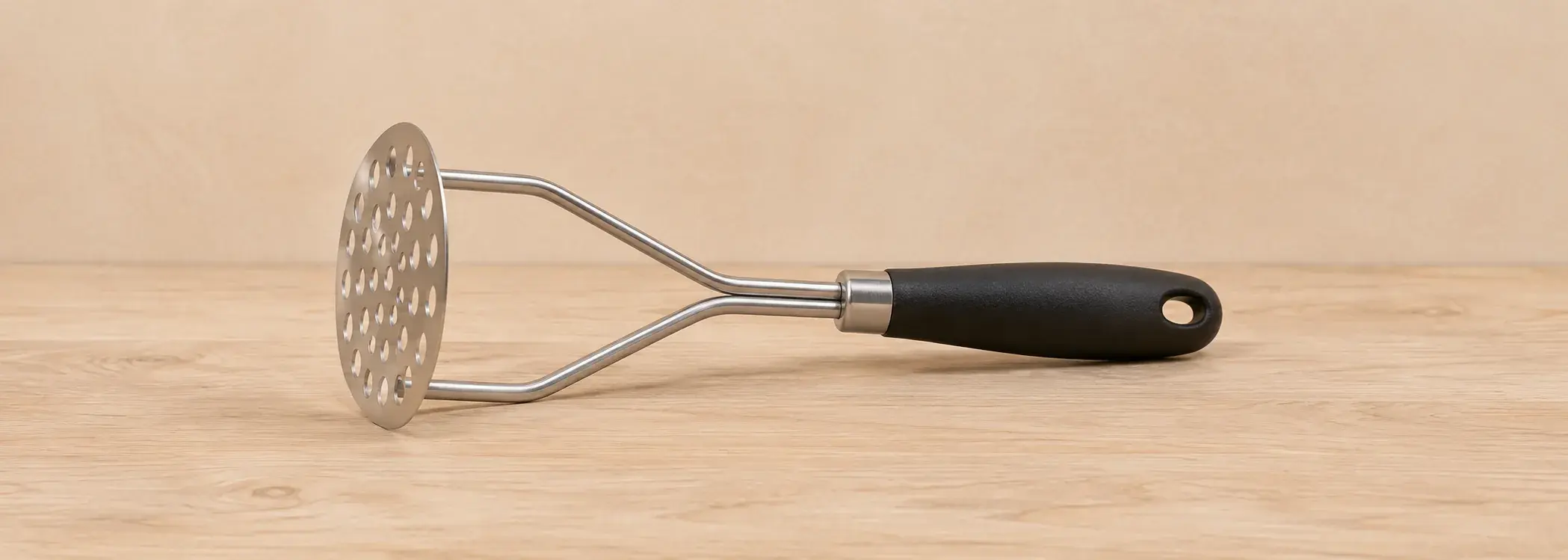
A potato masher can be perfectly intact and still feel awkward in your kitchen. A broad head may suit a wide bowl but leave too little room inside your usual saucepan. Before buying second-hand, compare the working end with the cookware you actually use. Overall length alone is not enough to judge either access to the bottom or comfort at the rim.
Match the head to the pan
Ask for the head's width and length, or its diameter if round, together with the distance from the head to the start of the grip. Compare the widest part with your pan's internal dimensions near the bottom, not merely its advertised rim diameter. Curved sides can narrow the working space considerably.
A photograph from directly above helps show whether the head is a perforated plate or a bent-wire design. Neither shape alone guarantees the texture you want. More importantly, the head should have room for ordinary movement without scraping along the sides. If trying it in person, use clean, empty cookware and avoid dragging an uncertain material across a coated surface.
Identify material before promising compatibility
Ask for the brand, model or any marking. OXO describes its Nylon Potato Masher as suitable for non-stick cookware. That statement belongs to the identified product; a black head on an unknown tool is not proof of the same material or compatibility. Check the saucepan maker's utensil guidance too.
Inspect the whole working edge and the spaces between openings. Look for cracks, chipped areas, peeling surfaces or heat distortion. Do not accept a rough damaged edge simply because the handle looks almost new. A coating or soft surface should not be assumed replaceable unless the manufacturer actually provides that option.
Hold it without performing a strength test
Take the handle in a relaxed grip and check whether there is room for your hand above the rim. Look at the neck and its connection to the head. Visible twisting, movement at a joint or a cracked grip should be disclosed. Do not bend the neck or press hard against an empty pan to test strength.
Ask how food is removed from the underside and around attachments after use. The cited OXO model allows dishwasher cleaning, but other materials and constructions need their own instructions. Wash and dry a used masher appropriately before preparing food.
A good listing includes a top view, a side view and the useful head measurements. Describe the actual wear and any gentle inspection performed. Avoid claims of effortless results based on appearance alone: the worthwhile purchase is a sound tool that fits both your hand and your pan.