


















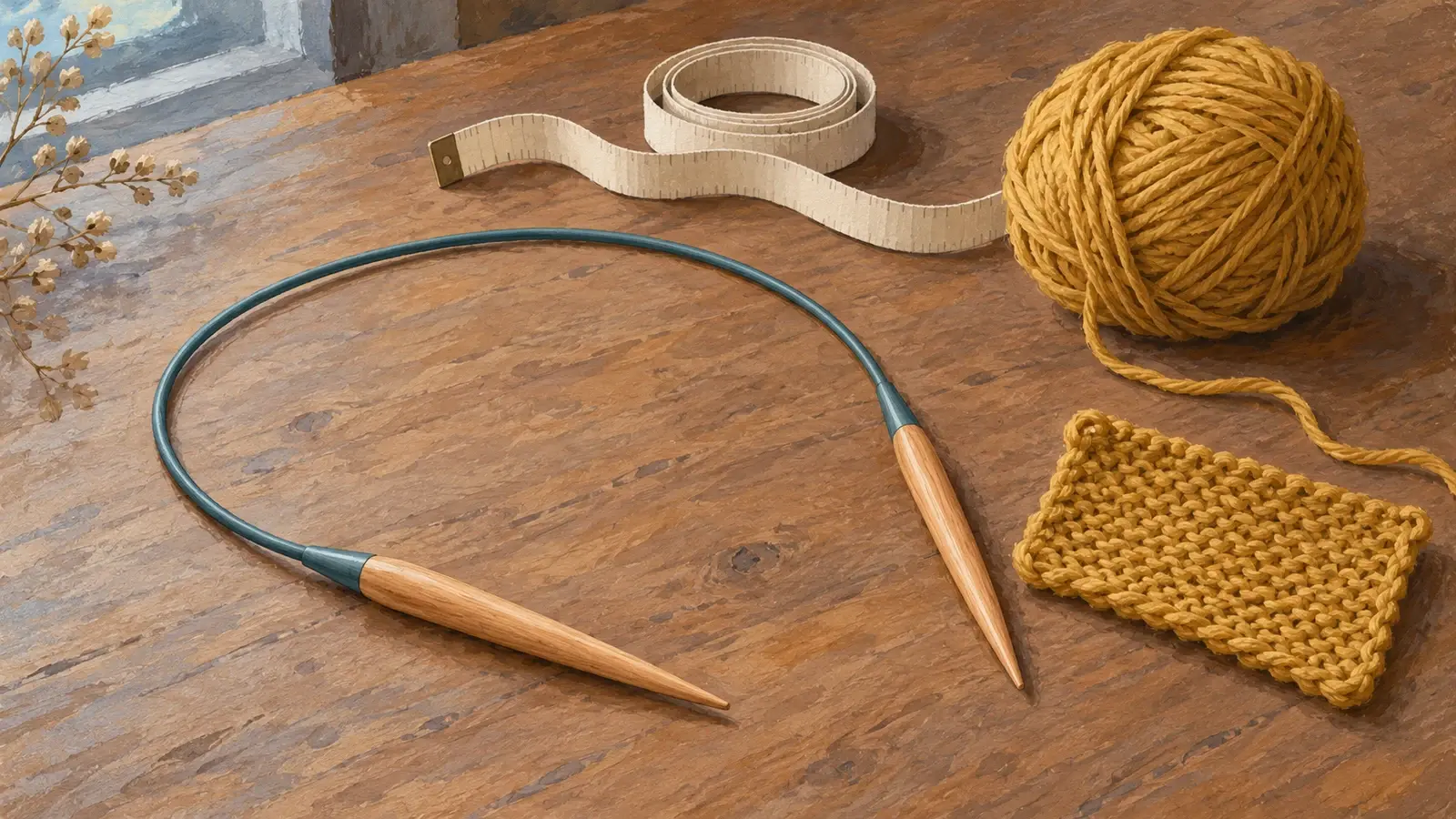
A circular needle listing gives a length, but the photograph shows only a loose cable. That can create an easy misunderstanding: the buyer expects one measurement while the seller has taken another. Before meeting, agree what the length describes and open the pattern for the project you have in mind. Build the set around the work, not around empty slots in a case.
Write down the project requirements
Copy the needle diameter, recommended length and knitting method from your pattern. Note any additional sizes needed for ribbing or finishing. Do not replace this list with a broad description such as “for a hat”: different constructions and techniques call for different tools. If you are still choosing the technique, settle that first. Buying extra cables does not resolve an uncertain project plan.
Establish what was measured
KnitPro labels interchangeable cables by the assembled needle's full tip-to-tip length.
Check another manufacturer's convention separately. Ask for a photograph of the complete needle beside a tape, without stretching the cable. Record the tip length too when it matters to the chosen set. A photograph of one detached cable, with no explanation, does not establish the assembled length.
Separate fixed and interchangeable designs
On a fixed circular needle, inspect both transitions into the cable. With an interchangeable set, identify the tip and connector series, not just the brand. Similar-looking threads are not proof of compatibility; do not force parts together. Check the combination against the manufacturer's information. If a tightening key or end caps are included, ask for them to be laid out separately. The word “set” does not say which small accessories remain.
Inspect the route a stitch follows
Look at the points, working surfaces, joins and cable in good light. Note burrs, cracks, sharp kinks and loose connections. Once the parts are confirmed compatible, and with the seller's permission, gently pass a spare piece of yarn over a join without putting a project on the needles. This may reveal a snag. It does not replace knitting a swatch or guarantee comfort during a long evening.
Do not identify size by colour alone
Record the visible diameter marking. If it has worn away, say so in the description, and separately report a check with a suitable needle gauge if one was actually made. Do not present an estimate as a factory marking. Make a swatch for your own project regardless: an identical number on two sets does not promise an identical result in your knitting.
Check the handover list
- Both parties understand the diameter and complete length.
- The series and compatibility of interchangeable parts are established.
- Points, joins and cable have been inspected.
- Keys, end caps and extra pairs are listed.
- Unclear markings and defects are shown separately.
Photograph the actual set being handed over. Label spare cables so that their length remains clear in storage. Leaving an unsuitable pair out of the purchase is preferable to planning to adapt it halfway through a project. A clearly described set saves time otherwise spent working out what you have.