

















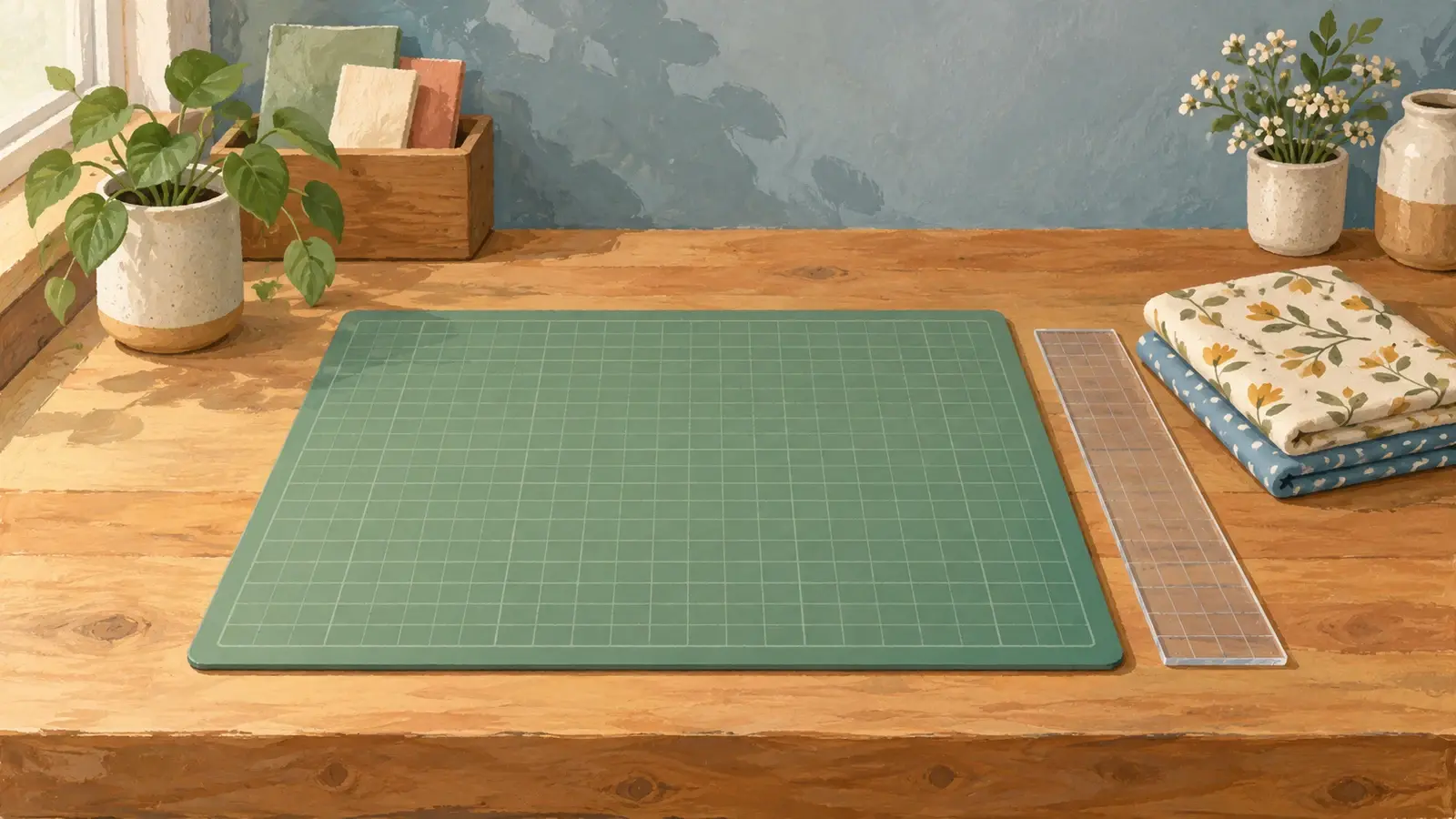
A large cutting mat is useful only when there is a suitable table and somewhere to keep it between projects. Before buying second-hand, measure the storage space as well as the work surface. Otherwise, the helpful new purchase may spend its time bent behind a cupboard or obstructing a passage.
Compare three measurements
Write down the mat's outside dimensions, the size of the marked working area and the free space on your table. These may differ. For a particular pattern or sheet of paper, the usable area matters more than the packaging width. Also establish whether the grid is marked in centimetres or inches rather than guessing from a photograph.
Lay a paper template of the required size on the table. Check whether there is still room for the ruler and material. The mat needs support across its entire surface; an overhanging edge is not a way to make a small table temporarily larger.
Inspect without trying to correct it
Ask for a photograph from above and another looking along the surface on a flat table. A raised corner or wave may be easier to see than in a frontal picture. Examine both sides in person. Do not hold a problem area down while judging flatness: that changes what you are trying to assess.
Photograph obvious grooves, cuts, worn markings and traces of previous projects separately. Not every mark is automatically a fault, but establish whether it interferes with your task. Someone laying out precise pieces needs a different amount of readable grid from someone seeking a protective surface for another permitted use.
Do not promise unlimited recovery
“Self-healing” does not mean every defect disappears. OLFA's FAQ identifies grooves and a grid that can no longer be read accurately as reasons for replacement. OLFA: FAQ — Rotary Mats
A seller's assurance that it will flatten at home remains unconfirmed. Do not buy on the assumption that heating will restore its shape. If the intended use or suitable tool is unknown, find the exact model's instructions before using it. Similar colours do not establish identical construction.
Plan transport and storage
OLFA recommends flat storage, no ironing on its mats and avoiding temperature extremes in a vehicle. OLFA: How to maintain your rotary mats
Check the instructions for other products separately. Before collecting the purchase, decide how to transport it without folding and where it will lie at home. Clear that space first, rather than after the large sheet is standing in the hallway. Do not make the mat a permanent resting place for miscellaneous hot objects.
Useful listing details
- Overall dimensions and the size of the working grid.
- Grid units and photographs of both sides.
- Flatness on a level support without being held down.
- Visible grooves, stains and worn areas.
- The known model and any available instructions.
There is no need to make trial cuts for a listing photograph. Begin by showing the surface and dimensions honestly. If the required working area is damaged, or there is nowhere to store the mat, choosing another size or declining the purchase is reasonable.