

















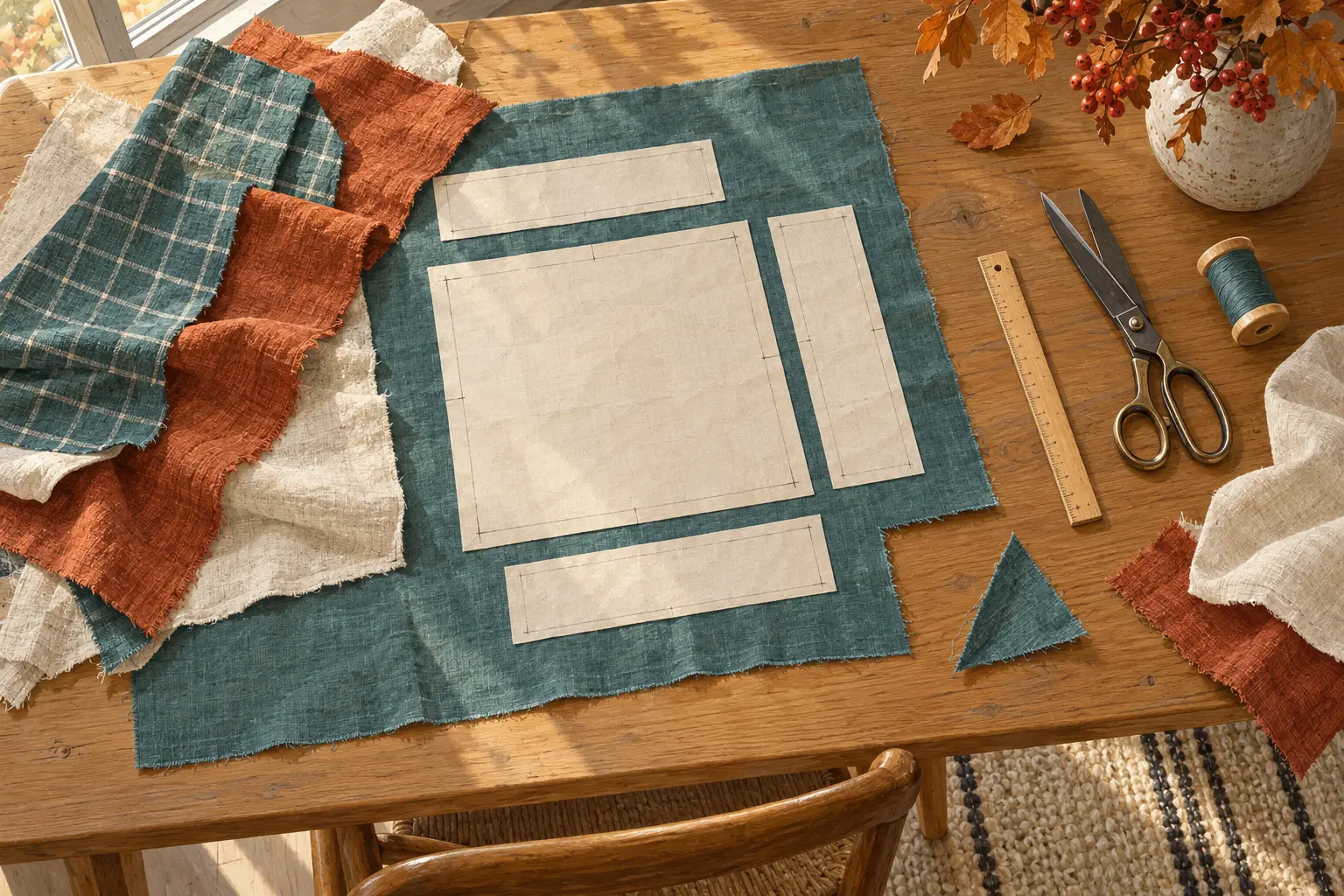
A bag of fabric remnants can suggest several projects. At home, however, a missing corner or an awkward print direction may prevent even one required pattern piece from fitting. Start with a small project you want to make, then compare its requirements with the usable cloth. A bag’s weight or approximate total length does not settle that question.
Choose the project before the bundle
Pick a specific pattern for something manageable, such as a simple cushion cover or pouch. Read its fabric recommendation, width requirement and cutting instructions before comparing listings. SINGER’s fabric guidance emphasises matching material and quantity to the pattern. A stretch fabric and a stable woven cloth are not automatically interchangeable. List required pieces and components, so a low price does not hide missing lining or fastenings.
Draw the cloth you can actually use
Ask for each piece to be laid flat, with a ruler showing its dimensions. Record the usable rectangle, missing corners, holes, stains and any joined sections. A long narrow strip cannot replace a wider piece merely because their areas are equal. Mark a directional print, pile direction and the available grain reference. If there is no clear edge or label, record that uncertainty rather than inventing a composition or grain direction from one photograph.
Clarify what the seller knows
Ask whether the fibre content is documented, whether the cloth has been washed and how it was stored. “Feels like cotton” is not the same as a known composition. Likewise, a clean appearance does not establish that the fabric has already shrunk. Request photographs of any original label and known faults. If your project needs dependable care information or a specific stretch, an unidentified bundle may be the wrong starting point even at an attractive price.
Prepare suitable fabric before the final layout
For material with known permitted care, prepare it as the finished item will be cared for before final cutting; this approach also appears in Utah Education Network’s sewing resource. It does not mean putting every remnant into a washing machine. Read the care information first: GINETEX identifies washing temperatures as maxima and distinguishes prohibited washing. If the material is uncertain or delicate, seek advice or test a spare sample with the owner’s permission rather than treating the whole piece.
Measure again and place the paper pieces
After the permitted care and complete drying, remeasure before placing the pattern. Consider this invented example: a piece measuring 50 × 50 cm before treatment measures 48 × 49 cm afterwards. Those numbers illustrate a planning problem, not a predicted shrinkage rate. Place the actual paper pieces on the available area, following the pattern’s grain and direction marks. Check whether seam allowances are already included so you neither omit them nor add them twice.
Leave a useful record for the next project
Mark which pieces you have prepared and keep their known fibre and care information together. Label remaining usable dimensions after cutting, not the dimensions of the original purchase. For irregular leftovers, a clear flat photograph may help more than an estimated total length. If you sell them later, show the cut-outs and disclose unknowns. Small pieces may still suit a different pattern, but do not promise a finished item unless its actual cutting layout has been checked.
A compact plan before buying
- Choose a pattern and read its fabric requirements.
- Record each piece’s usable dimensions and defects.
- Separate documented composition from the seller’s guess.
- Clarify permitted care and any previous preparation.
- Check the full cutting layout, including seam allowances.
A useful Zeppik listing describes the individual pieces, not just “a big bag of fabric”. For the buyer, the best result may be a smaller bundle that genuinely fits the chosen project. Measure, prepare where appropriate and lay out the pattern before cutting. That keeps an inexpensive remnant from becoming an unfinished project simply because its usable area was never checked.