
















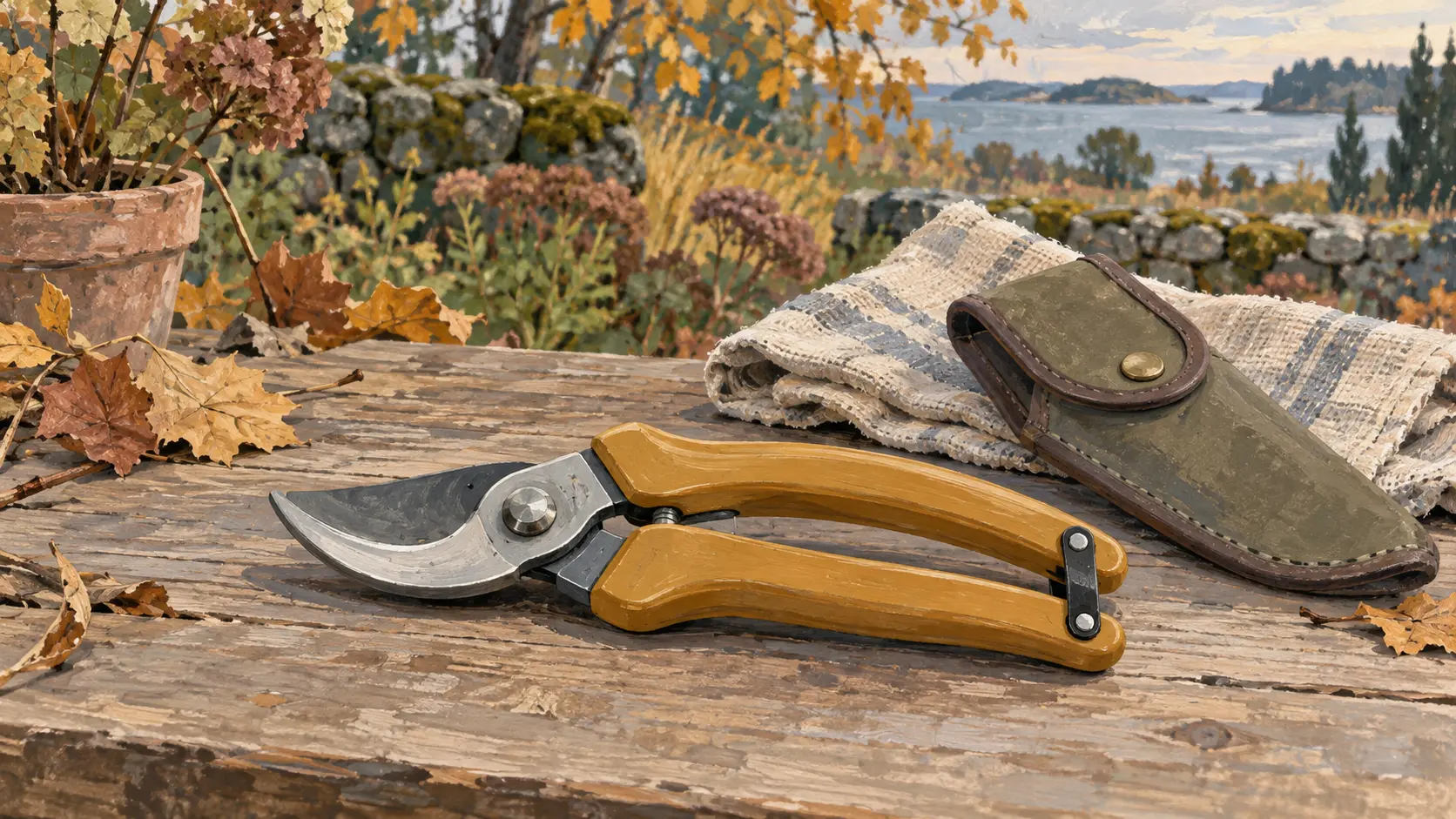
Sorting garden tools before autumn clean-up is a good moment to decide whether used secateurs are worth collecting. This guide concerns ordinary manual secateurs, not battery-powered cutters. It is a buying checklist, not a recommendation to prune every plant now: the right pruning time depends on the plant and task.
Match the tool to your hand and job
Ask for the exact model and a photograph of its markings. Check the maker’s intended use, handedness, handle size and stated cutting limits rather than judging from a photograph. A tool that opens too widely for your hand may be awkward even when its blade is sound. Do not choose a tool by the thickest branch someone claims to have cut. Plan another suitable tool for work outside its instructions, not more force on the handles.
Request clear photographs of the complete tool
Ask for both sides, the pivot, lock, handles and the whole cutting edge. The owner should position the tool safely for photographs, with fingers away from the cutting area. Look for cracks, bent parts, missing fasteners, deep corrosion and broken handle coverings. Distinguish a worn finish from a structural defect. Dirt or sap can hide the surface; ask for appropriate cleaning by the owner rather than scraping or dismantling the tool yourself at a meeting.
Check the catch and normal movement
Only if the tool appears complete and undamaged, ask the owner to demonstrate normal opening, closing and locking according to its instructions. Keep your hands clear and do not force a jammed mechanism. The catch should hold the closed position as intended; a spring and any buffers should be present where the model requires them. If the lock does not work or a component looks cracked, stop the demonstration. A moving mechanism is not proof of a sound cutting edge or safe remaining service life.
Do not turn blade inspection into sharpening
Look at the edge in good light, without running a finger along it. Chips, a bent tip and uneven previous sharpening deserve an explanation. Ask whether the tool has been used on materials outside its intended purpose or repaired with non-matching parts. This is not the moment to adjust the pivot, replace a spring or try cutting wire. If the condition remains unclear, obtain a competent service assessment or choose another pair. No cutting test is needed to reject obvious damage.
Identify parts before counting a repair as cheap
A manufacturer’s name is not a part number. FELCO’s official parts catalogue is organised by tool model. Use the actual model to identify the needed item and confirm compatibility, availability and delivery cost. The existence of a catalogue does not prove that every part is available in Estonia today. Do not fit an apparently similar blade or spring on guesswork, and do not assume a second-hand purchase has a transferable warranty.
Agree the present condition and total cost
Ask about previous servicing, storage and any unresolved defect. FELCO publishes separate maintenance demonstrations for different models; that is a reason to find the correct instructions, not to copy another tool’s procedure. Add confirmed servicing, parts and collection to the purchase price. If essential repair cost is unknown, compare the tool as needing assessment, not as ready to use. Sellers should list repairs and missing pieces plainly.
Before agreeing
- Model, intended task and hand fit are clear.
- Handles, pivot and blade have no unexplained damage.
- The owner has shown the catch and normal movement safely.
- Required parts and servicing are identified and priced.
- Closed, protected transport and storage are arranged.
Choose an understandable condition rather than a promise of an easy sharpening job. A tool you cannot assess without unsafe experimentation is not a bargain you need to accept.