

















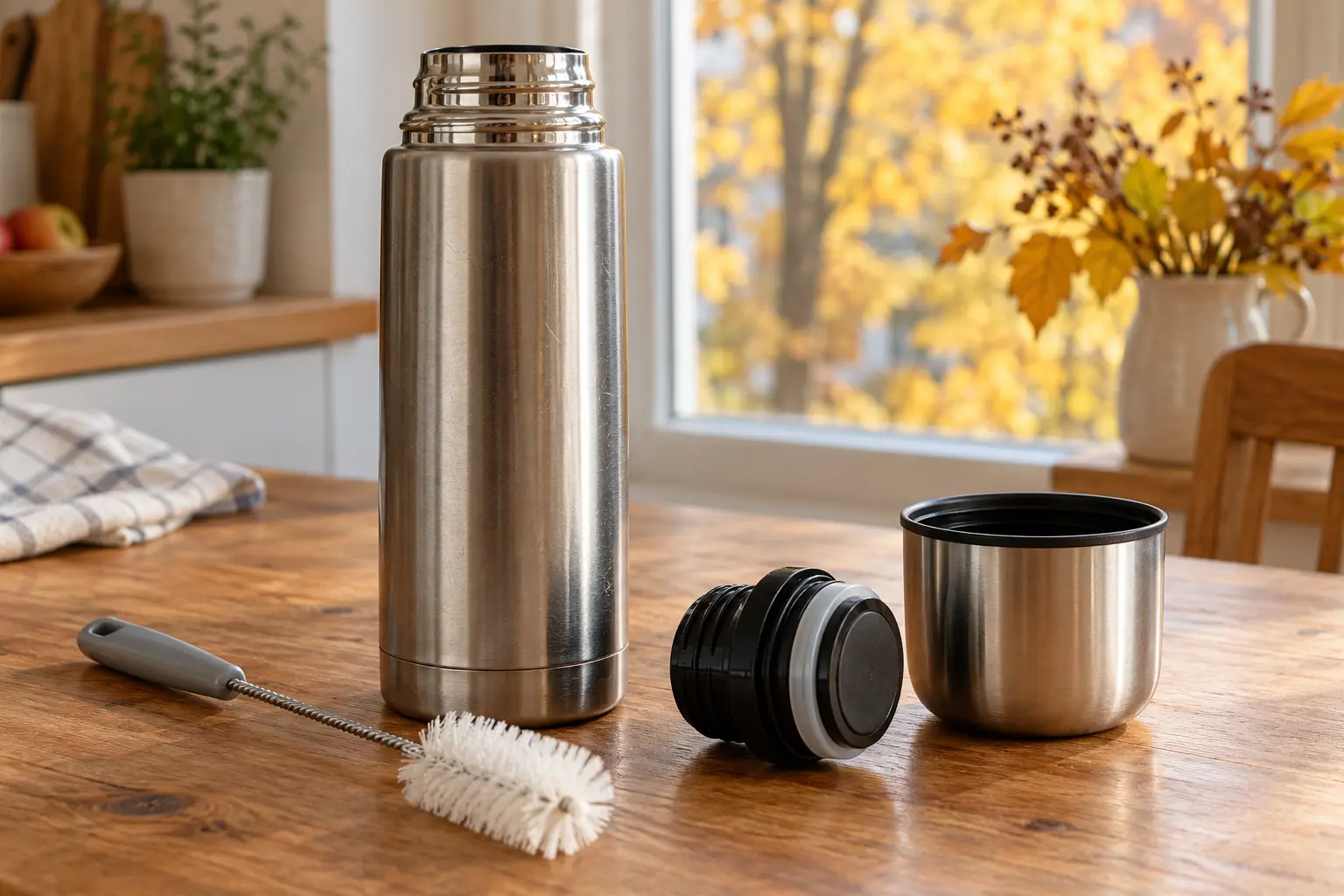
A warm drink can make an autumn walk in Estonia more comfortable, whether you are stopping beside a forest trail or waiting for transport home. A second-hand thermos can be a sensible purchase, but a polished body and a familiar logo are not enough. What matters is whether this particular flask is complete, cleanable and suitable for the way you will carry it.
Start with the model, not the colour
Ask for a clear photograph of the base, the stopper and the open neck. Establish the capacity, model and intended use. An insulated water bottle is not automatically intended for hot drinks, and a splash-resistant mug is not necessarily suitable for lying inside a backpack. Look up the actual instructions rather than relying on a similar-looking product.
Check recall information using that precise identification. The Stanley EU recall notice lists particular Switchback and Trigger Action mugs whose lids require replacement. An unresolved recall is a reason to stop the purchase, not negotiate a discount. For any brand, ask the manufacturer if the model or replacement lid cannot be identified confidently.
Look closely at the parts that meet
Open and close the stopper without forcing it. Inspect the threads, drinking edge and seal for splits, distortion or missing sections. Ask whether the lid is original. A part that happens to screw on is not proof of compatibility. Check the cup and handle too, and place the flask on a flat surface to see whether it stands securely.
Exterior scuffs may be acceptable to you; a damaged neck, loose base or unexplained internal damage is a different matter. Ask for well-lit photographs inside. If marks, odours or damage cannot be explained and assessed, walk away. Include the cost and availability of the correct replacement parts when comparing the asking price with a complete alternative.
Make cleaning practical
Check whether the opening admits your bottle brush and whether the stopper can be disassembled as instructed. Complicated mechanisms deserve close attention: ask the seller to show the removable pieces together, so you can see what is included. Do not prise apart a sealed assembly or improvise a replacement gasket.
Thermos directs owners to each product's care manual; dishwasher compatibility must not be assumed. Stanley's care advice recommends a soft brush rather than a metal one. Use the model's approved cleaning method, rinse thoroughly and let the parts dry. If an objectionable smell remains after appropriate cleaning, do not buy on the promise that stronger chemicals will solve it.
Test leaks with cold water first
With the seller's agreement, use plain cold water over a sink, close the flask correctly and check for leakage in positions allowed by its instructions. Dry the outside first so spilled filling water does not confuse the result. Never use hot water for a shake or inversion test. A brief successful check does not guarantee future leak resistance, but visible leakage needs an explanation before purchase.
Compare warmth without inventing a rating
For a model approved for hot drinks, an adult can arrange a simple stationary water test on a stable surface, away from children. Follow the manufacturer's guidance on preheating and filling. Record the water volume, starting temperature, room conditions and elapsed time. A suitable kitchen thermometer can record the temperature after, for example, two hours; tasting is not a measuring method.
Treat this as a practical comparison, not a certified insulation test or proof of food safety. Different fill levels and conditions make results hard to compare. Ask sellers to describe what they actually measured rather than repeating an original “keeps hot” claim. For your first outing, choose a short route and carry the flask upright until you know its behaviour.
Before you agree a price
- Confirm the exact model, capacity and permission for hot drinks.
- Resolve recall questions and verify the correct lid.
- Inspect seals, threads, interior and standing stability.
- Check cleaning access and the price of necessary parts.
- Agree a cold-water leak check and record any warmth test honestly.
- For a listing, photograph wear, list every included piece and disclose anything untested.
A useful thermos is one you can confidently clean, close and carry—not simply the cheapest attractive bottle.