


















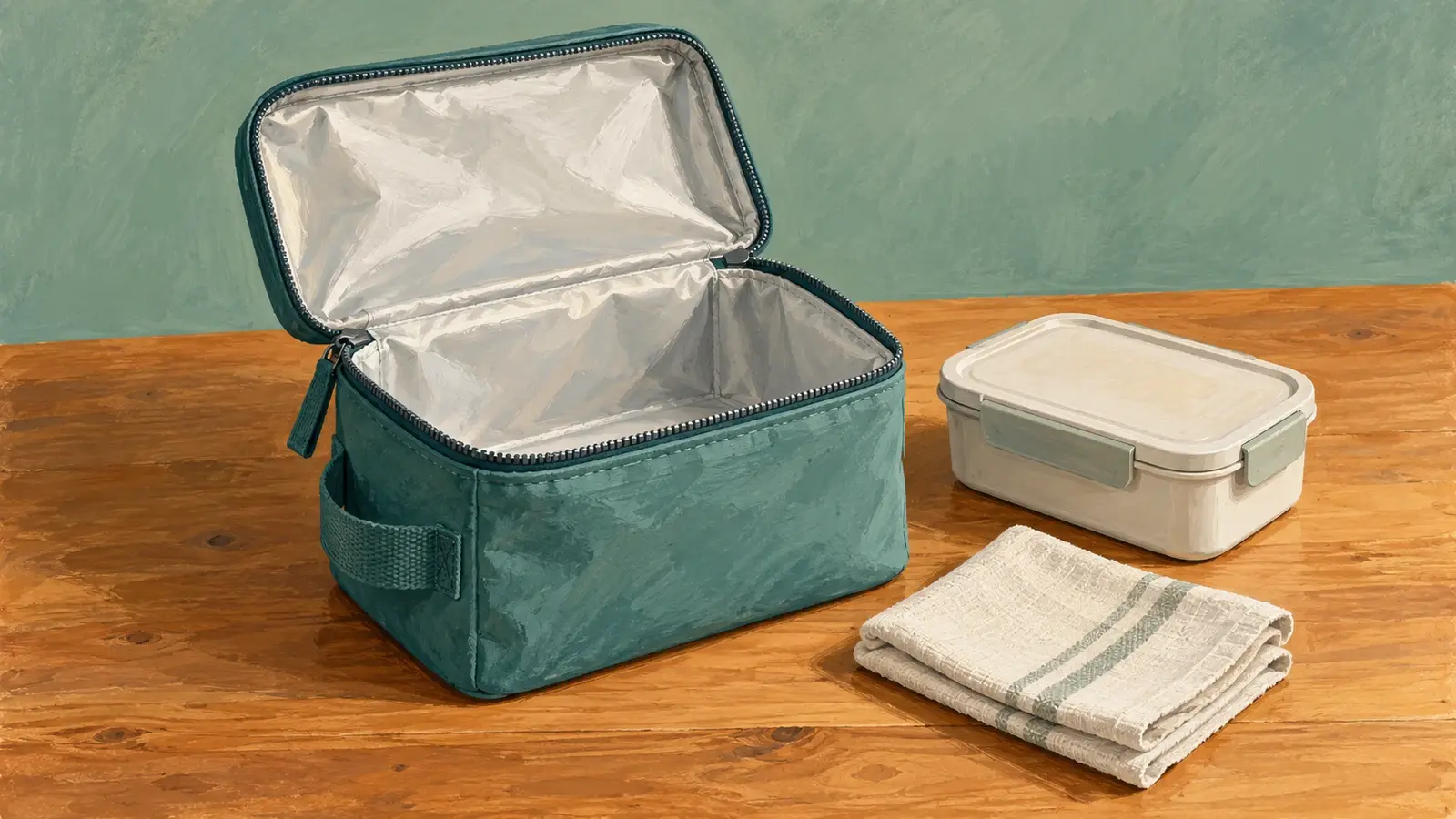
A small lunch bag is easily left closed inside a backpack until the next working day. When unpacking after a trip or preparing the bag for sale, open it fully and remove everything. You can then assess the inside rather than judging the whole item by a tidy outer pocket.
For a before-and-after comparison, photograph the open bag as a whole and take close views of the areas you notice. Keep the lighting consistent so you can distinguish a real change from a mark simply becoming less visible in a photograph.
Start with an empty bag
Place it on a dry surface in good light. Inspect the bottom, corners, inside of the lid and accessible seams. Look separately at the places where the edges of a container have rested. A small fabric mark and a separating inner seam are different faults; do not group them together as “some wear”.
Do not force an attached lining inside out. If part of the inner layer is concealed, record that limitation. Do not promise that stickiness, peeling or a persistent smell will disappear with cleaning. First establish with the manufacturer whether the condition permits further use.
Check the fit and closure
Measure the usable interior, particularly the base width and height beneath the closed lid. Outside dimensions do not show whether your usual container will fit. Use a clean, empty container for a trial and do not stretch the bag to make the dimensions work.
Inspect the handle, its attachments and the closure. Open the zip or other fastening as intended, without pulling sharply. If there is a removable strap, establish whether it is included. A listing benefits more from the actual inventory than from a model name copied from a shop page.
Separate different models' instructions
Find the label or instructions for your own bag. For example, YETI prohibits machine washing and drying its Daytrip Lunch Bag and recommends storing it unfolded. YETI: Daytrip Lunch Bag FAQ
This is a narrow example, not a care method for every insulated bag. Another design may have a different coating, insulating layer, fastening or removable components. Do not replace missing instructions with your usual backpack wash cycle. Photograph the label before cleaning to preserve legible information for the next owner.
Plan how cleaning will finish
Before starting, choose the permitted method and a place where the bag can dry in the position specified by its manufacturer. Do not invent a drying time from the thickness of the outer fabric. Check accessible folds and seams before closing the bag and putting it away.
Do not add fragrance to conceal a smell or make a cleaning solution stronger by guesswork. If a fault remains after permitted care, describe it directly. Check the storage instructions too: folding compactly for transport does not necessarily mean the same arrangement is suitable for long-term storage.
What you can honestly tell a buyer
- The exact model and usable internal dimensions.
- The condition of lining, seams, handle and closure.
- Whether the strap and other detachable parts are present.
- Whether the label remains and how the bag was cleaned.
- Which defects remain or could not be inspected.
This inspection concerns condition and convenience, not safe food-storage time. A clean lining and intact zip do not demonstrate a used bag's thermal performance. Do not advertise hours of cold retention without verified information relevant to the exact model and conditions.