


















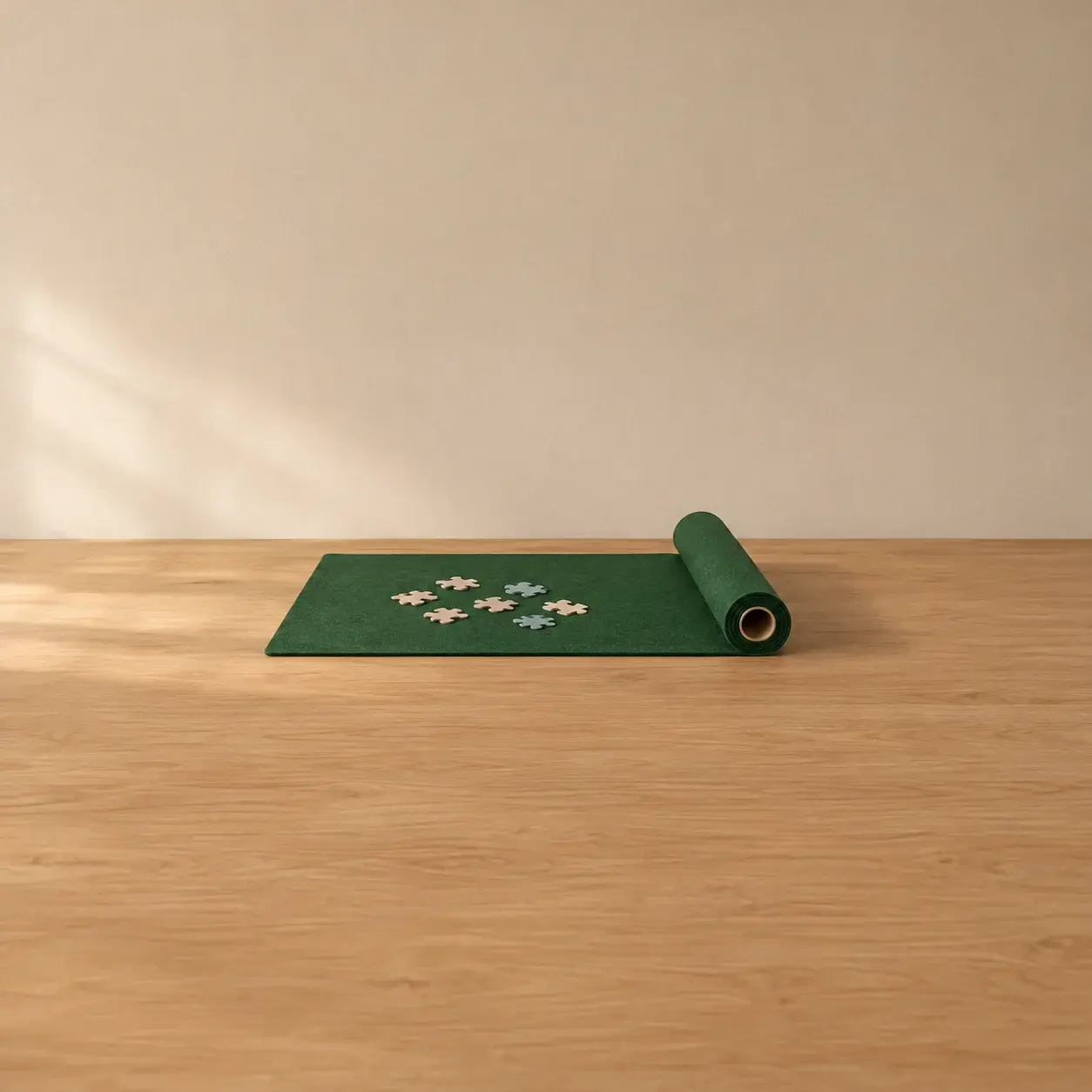
An unfinished puzzle can take over the dining table for several evenings. A second-hand mat or board may make clearing the table easier, but only if the storage method suits your room. Start with where the puzzle will go between sessions, rather than the piece count printed on an accessory box.
Measure the picture and its parking place
Find the finished dimensions on your puzzle box. Compare them with the usable surface of the accessory, excluding borders, seams and raised edges. A long panoramic puzzle needs different proportions from a conventional rectangle, even when both contain the same number of pieces. Allow separate space for sorting if the picture fills most of the surface.
Then measure the intended shelf or space under furniture. A board needs a clear route and a place where the whole surface is supported. A roll needs enough length and clearance for its rolled diameter. Ask for measurements in the stored position, not just a photograph that makes the item look slim.
Inspect the construction you are actually buying
Ravensburger's Roll Your Puzzle combines felt, a tube and straps. Its Puzzle Store uses a rigid case and separate puzzle base. These illustrate different designs; their features do not establish the condition of a used accessory.
Spread a mat on a flat table. Look for stubborn folds, stretched patches, loose fibres and dirt. Ask how it was cleaned and stored. Do not assume that ironing or soaking will restore it: check the instructions for that material first. Examine straps for deterioration and check that every tube section connects properly.
For a board, inspect the underside, corners and edges. Check whether it rocks on a level surface. If there are inserts, a cover or closures, try each one. An open board is not automatically suitable for carrying upright, and a missing insert may change how a case holds its contents.
Try packing it away
- Compare the contents with the instructions for the exact model, including small fasteners and removable parts.
- With the seller's agreement, use a few spare pieces and a small assembled section for a trial.
- Pack and reopen the accessory as instructed, without extra pressure or sudden movements.
- Check whether pieces catch on the surface and whether the process is manageable alone.
This is a useful convenience check, not a guarantee that a large puzzle will remain untouched. Use ordinary spare pieces rather than a valuable puzzle. If something shifts or the mechanism is unclear, establish why before buying.
Make a useful listing
Photograph the accessory open and packed, then show the surface and closures closely. Give the usable dimensions, included parts and visible wear. If only the mat is included, say explicitly that the tube is missing.
Choose the option you can comfortably put away after an evening's puzzling. A tidy-looking board is of little help without a flat storage space, while an incomplete roll-up set may create another shopping task before you can use it.