


















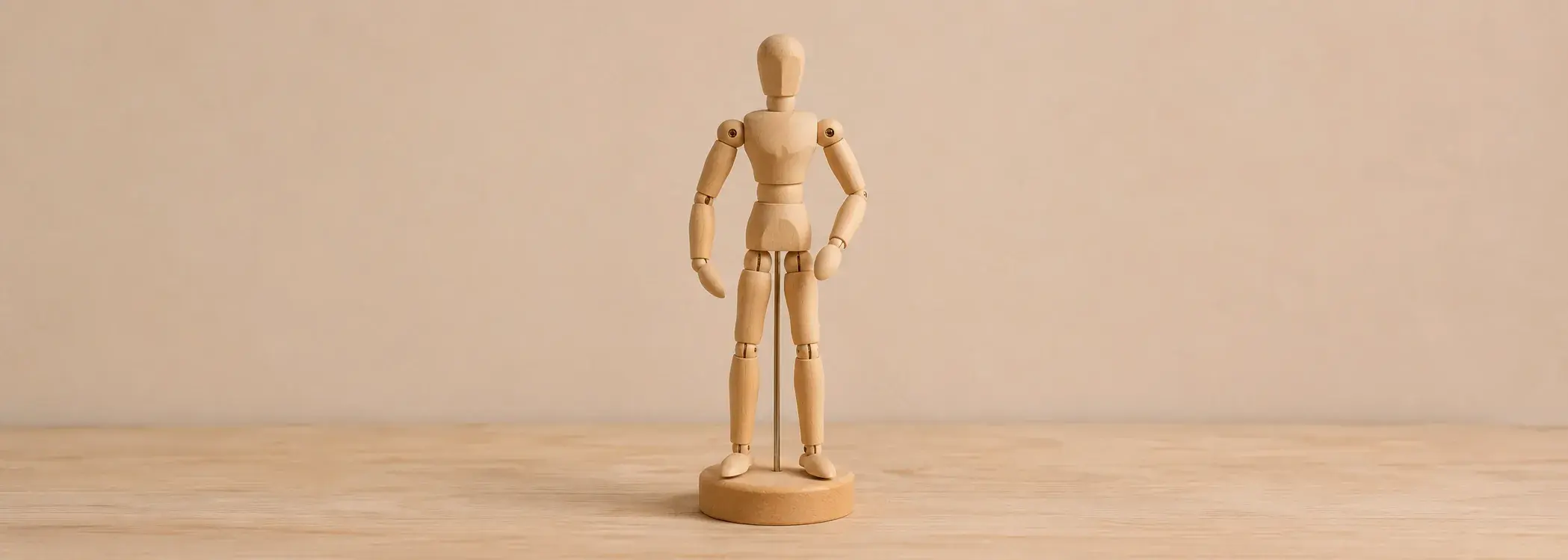
A wooden artist mannequin is easy to judge as a decorative object and harder to judge as a drawing aid. An attractive finish does not show whether an elbow stays where you put it. If you want to sketch from the figure, start with the joints, its support and the poses you actually use rather than the colour of the wood.
Ask what the set includes
Request front, side and rear photographs, including the connection between the figure and its stand. Ask for the overall height with the base and the figure height separately. These measurements answer different questions: one helps you plan shelf space, while the other tells you how large the model will appear on your drawing table.
Check whether the base, support rod and any removable parts shown are included. A repair is not automatically a reason to reject the figure, but ask where it was made and whether it affects movement. Visible glue around a shoulder deserves a closer look before you assume that joint still works.
Move gently, then let go
Place the mannequin on a level table. With the seller's permission, support the adjoining body section and gently change one joint at a time. Never force a limb past its natural mechanical stop. Compare both sides, while allowing for the fact that the design may limit movement in particular directions.
Choose a simple pose with one arm raised and a leg slightly bent. Release your hands and watch whether the parts gradually drop. Repeat with another modest pose. You are checking whether this particular figure holds the positions you need, not demanding that it reproduce every human movement. Daler-Rowney describes articulated joints and simplified forms in its wooden manikin range; this does not establish the condition of a second-hand example.
Inspect the support as carefully as the figure
Look for cracks near joint openings, loose connections, splinters and missing wooden sections. Check whether the support turns unexpectedly in the base or the base rocks on the table. Test stability in an ordinary balanced pose, not by deliberately pushing the figure toward a fall.
For cleaning or adjustment, follow the identified model's instructions. Do not add oil, tighten concealed mechanisms or pull joints apart simply to improve a brief test. A simplified mannequin can help you observe poses and shadows, but it is not a promise of anatomical precision. Buy it when the working joints, stable support and size suit your practice. In a resale listing, describe the actual movement tested and photograph any repairs instead of calling the figure “perfect for every pose”.