


















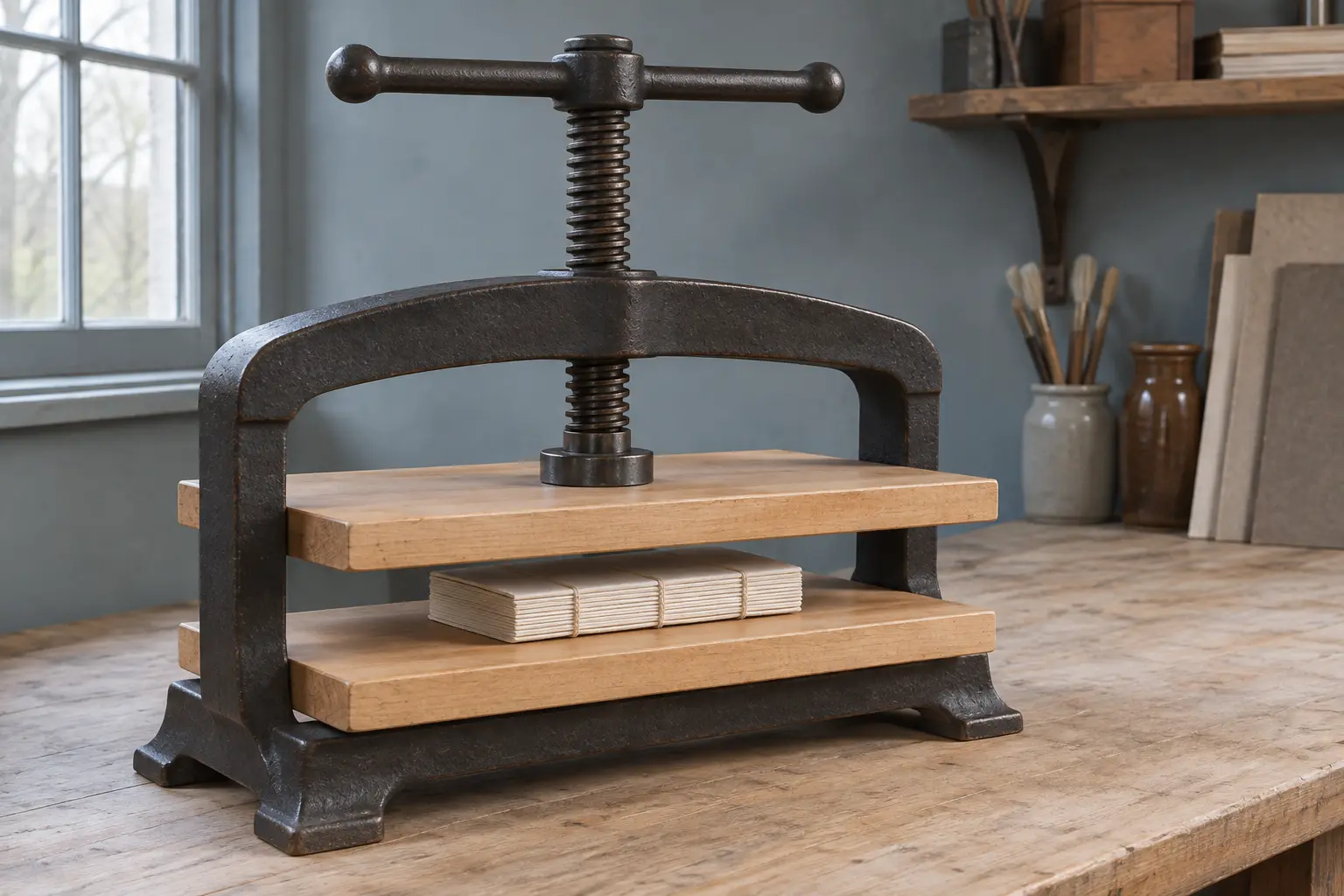
Measure the space your work needs
Start with the widest book you actually plan to bind. If it goes between pressing boards, measure those boards and the thickness of the whole sandwich: book, boards and any interleaving. At the press, measure between the uprights and between the fully opened platens. An A4 label does not tell you whether your boards will clear the uprights or whether you can slide the sandwich in from the side.
Check the screw unloaded
With the seller’s permission, turn the screw through its ordinary unloaded travel. Look for binding or a moving platen that tilts. Check that the frame, handle and bench edge leave room to turn the handle and remove your work. If the frame is cracked or the platen has noticeable play, stop before testing under load.
Dry-fit a disposable sandwich
Bring two clean, flat sacrificial boards and a scrap-paper stack about as thick as the intended book. Centre the sandwich and first slide it in and out without tightening. Set identical strips of paper near the four corners of the top board, with the ends sticking out. Lower the platen to light contact and compare how readily the strips pull free. If one is pinched while another slides freely, open the press, turn the sandwich half a turn, and repeat. If the loose strip stays on the same side of the press, look at the platens and guides. If it follows the sandwich, check the boards and paper stack first. This compares contact, not pressure.
Plan the trip home
Ask for the weight and external dimensions, and whether the maker’s instructions allow the handle to be removed. Measure the vehicle opening and the route to the bench. Arrange help and a way to secure a heavy press before collection. Do not carry it by the screw or operating handle. If you cannot see the measurements or a dry fit, treat suitability for your format as unconfirmed.