

















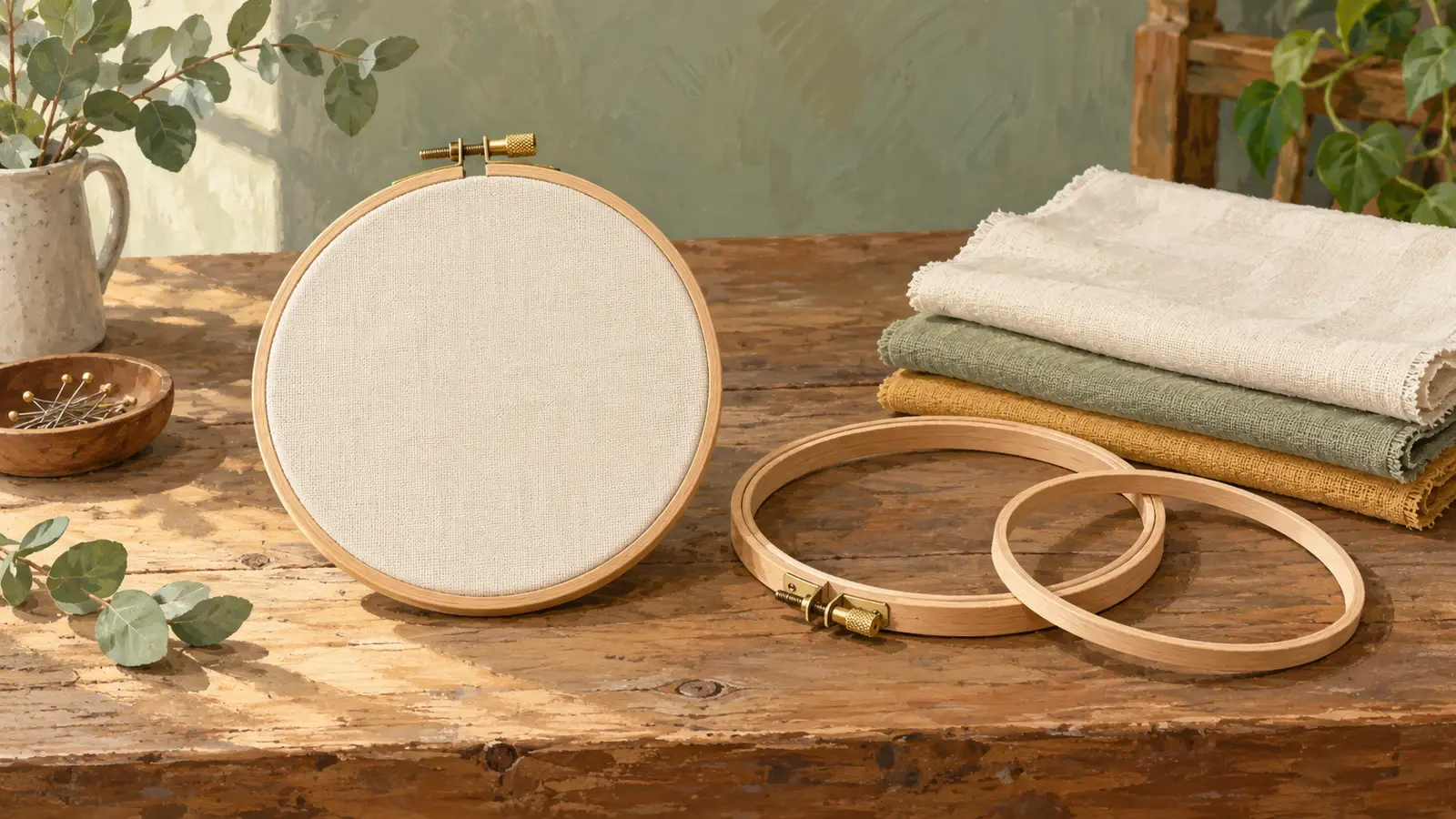
An embroidery hoop can seem like nothing more than two simple circles. Before buying one second-hand, establish how this particular pair holds your fabric. Attractive wood or a finished embroidery inside does not reveal the inner ring or fastener's condition. Ask to inspect the empty hoop and choose a small spare fabric piece for an agreed test.
Separate a working tool from decoration
Establish whether the item is a working hoop or a decorative frame containing finished embroidery. Do not ask to dismantle someone else's work if it is sold as a finished object. In that case, hidden surfaces remain uninspected. This guide concerns hand embroidery: compatibility with an embroidery machine needs a different model-and-mounting check, not simply a diameter comparison.
Match the size to your project
Measure your design's working area and ask for the hoop's internal size. Consider how you will hold it and whether there is fabric around the design. Do not cut your project piece precisely to the outer ring for a trial. If you want to use a stand, establish its mounting compatibility separately. A diameter in a listing describes neither grip comfort nor the fastening assembly's full dimensions.
Inspect both rings
Ask to see the parts separately and assembled, without fabric hiding them. In even light, inspect edges, joints and surfaces that will touch the cloth. Note cracks, chips, roughness, adhesive traces and distortion. Do not press a finger along a suspect edge. Ask whether the rings originally belonged together: similar size does not replace checking how they fit as a pair.
Check the fastener without force
Look for the screw and its matching component, misalignment and visible damage at the mounting. Ask for normal loosening and tightening as the design permits. Do not turn the inspection into a repair with pliers or an attempt to force damaged threads. If the fastening works only with an unusual manoeuvre, describe that directly rather than calling it a trick used by experienced stitchers.
Try a suitable scrap
DMC describes a hoop as a tool for holding fabric taut during hand embroidery.
With the seller's permission, check the function using clean spare cloth similar to your project's material. See whether it stays evenly held during ordinary handling and whether any obvious snag appears. Do not stretch the scrap out of shape to achieve a result. A short trial does not guarantee the same behaviour with every fabric.
Record before buying
- Intended use and internal dimensions.
- Condition of both rings and fastener.
- Confirmed contents of the matching pair.
- Material used for the trial.
- Defects and limitations of the check.
For a listing, show the whole hoop and problem areas separately. If cloth conceals a surface, say so. Choose an understood working pair rather than assuming an unidentified defect can simply be sanded away after handover.