


















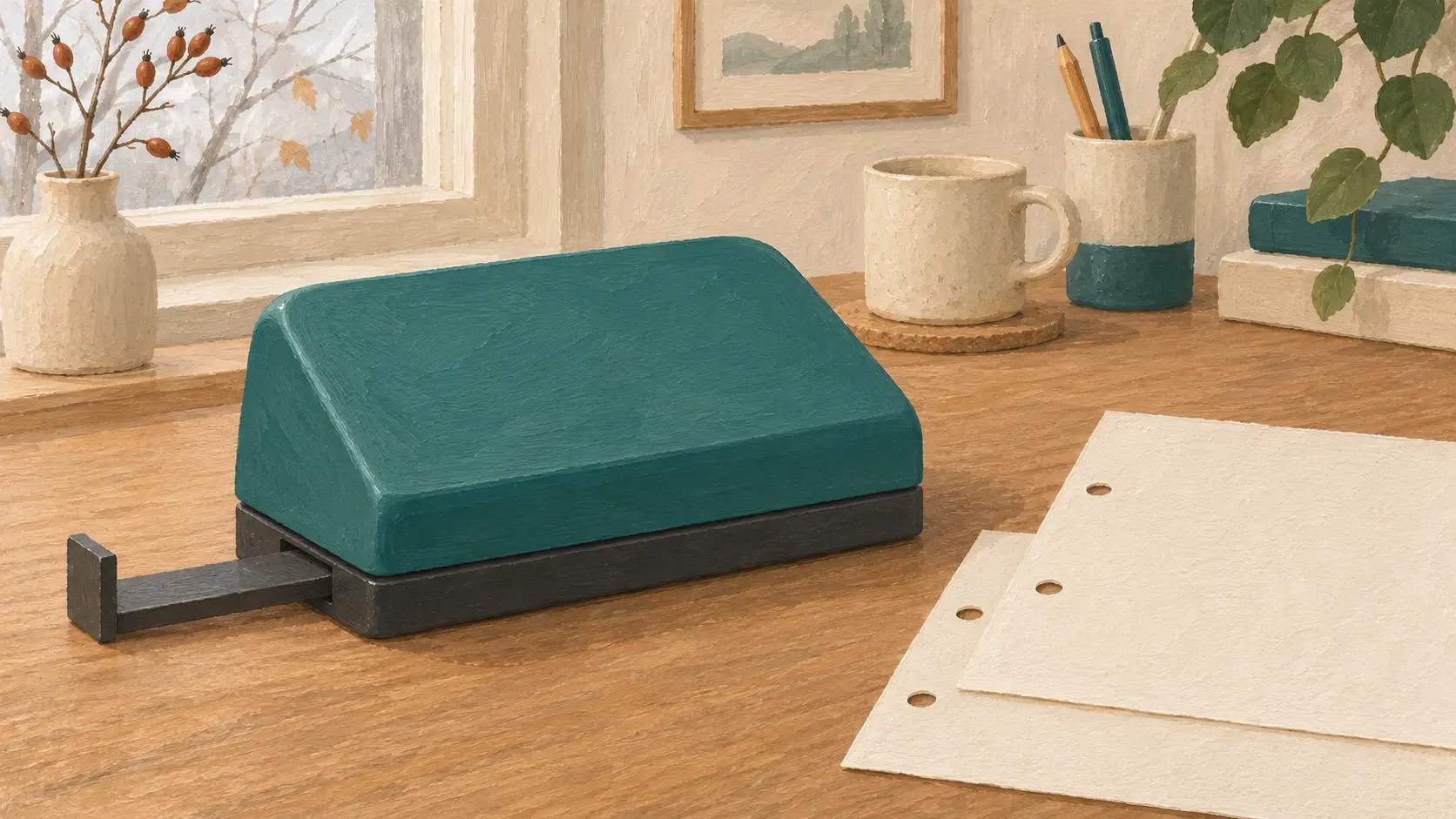
A hole punch can look complete while a loose paper guide makes every sheet sit differently in a binder. Before buying a second-hand one, choose the folder you actually use and a few disposable sheets of the right size. A small practical test tells you more than a photograph of the handle or an ambitious sheet-count claim.
Begin with the binder
Count its rings and check where they sit. Two holes, four holes and organiser patterns are not interchangeable simply because the paper is A4. Bring a disposable sheet that already fits the binder, or write down the required pattern. Do not use a certificate, photograph or original document as a test piece. Keep valuable papers in suitable sleeves when holes are not wanted.
Check the guide separately
The Rapesco ECO description includes a calibrated paper guide. On a used punch, check that the guide is present, its marks can be read and the intended setting stays in place during ordinary use. Ask the seller to show the full tool from above and below. A missing guide should appear in the description, even if the cutters still make holes.
Read capacity with its conditions
The Rapesco 75-P specification ties its sheet capacity to 80 g/m² paper. Treat that as a reminder to find the conditions for the exact model, not as a capacity for another punch. A stack of thick dividers is not equivalent to the same number of ordinary sheets. Start the inspection with one permitted scrap sheet rather than testing the maximum load.
Compare the results
Place the punch on a stable surface and follow its normal operating instructions, keeping fingers away from the cutting openings. Check whether the holes are complete and whether the sheet fits the binder without pulling or folding. Repeat on another sheet at the same setting, then compare the positions. A simple successful test is useful evidence of that test only; it does not establish remaining service life.
Look underneath before paying
Examine the accessible base, handle and tray for cracks or missing pieces. Rapesco lists an opening waste tray on the example model, but the seller must show the emptying method for this actual tool. Do not reach into cutters or dismantle a jammed mechanism. If ordinary operation needs force beyond the instructions, stop and treat the fault as unresolved.
Describe the handover accurately
Include the model, hole pattern, guide and tray in the listing, along with photographs of the test sheet and visible damage. Say whether a test was performed and what paper was used. Check replacement-part availability before assuming a missing item is inexpensive. A smaller complete punch that fits your binder is preferable to a heavy model whose guide or cutters need unexplained repair.