

















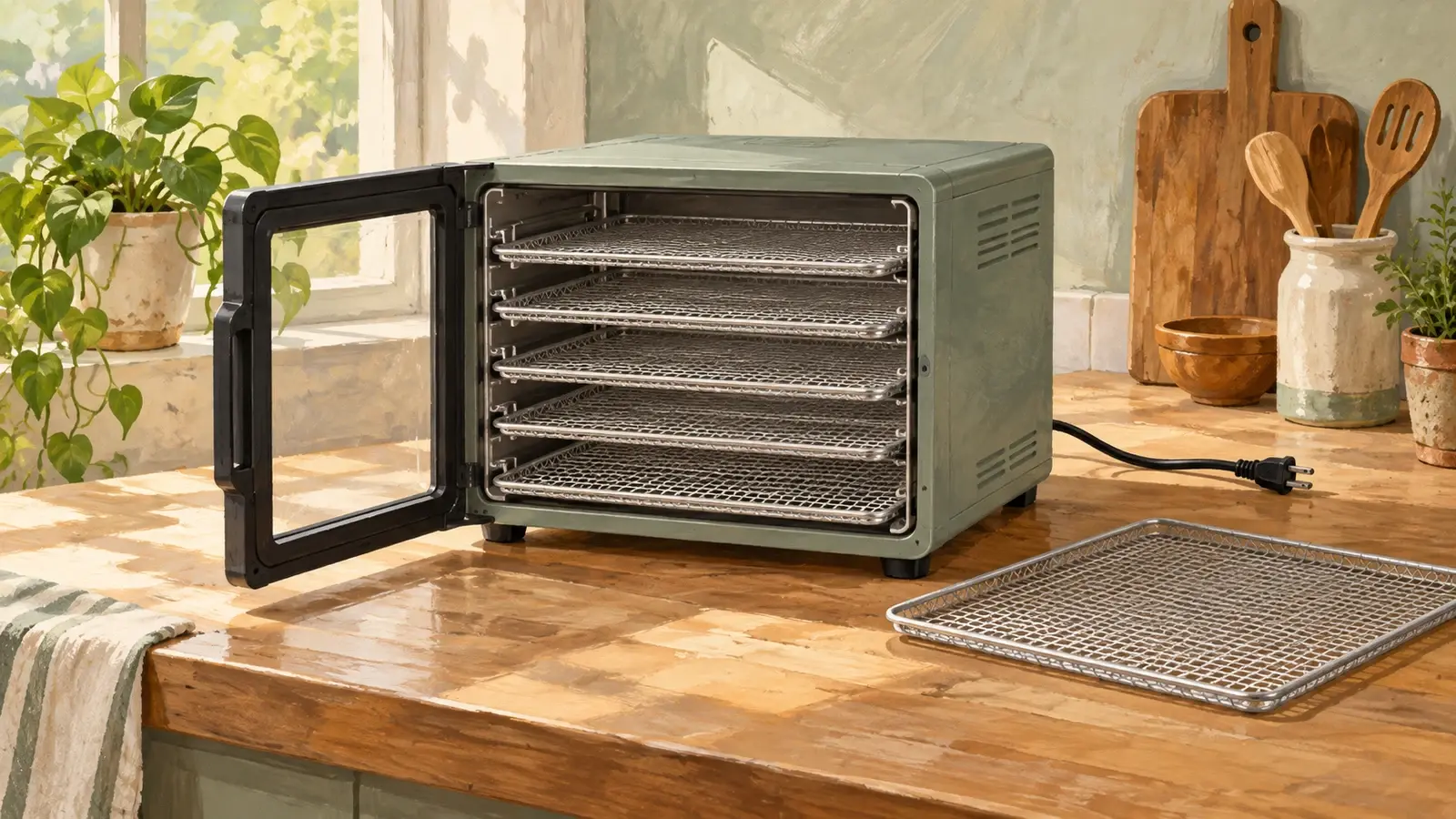
“Lots of trays” tells you little about whether a used food dehydrator is complete. A photograph may show drying racks, mesh inserts and a crumb tray together. Before meeting the seller, separate them by purpose and compare the inventory with the exact model's parts list.
Begin with the rating plate
Ask for a legible photograph of the manufacturer's plate, not just the door logo. Record the full model reference and find its instructions. For an appliance brought from another country, check its power-supply markings separately: a similar name does not establish suitability for the local mains.
If those details are unclear, ask the manufacturer or a qualified specialist before switching on. A random plug adaptor is not proof of compatibility. A damaged cord, plug or casing also rules out a trial simply for the meeting.
Count different parts separately
Ask for only the user-removable parts specified in the instructions to be laid out on a dry surface. Make separate entries for drying trays, mesh inserts, solid sheets, a collection tray and other accessories. Do not add everything together into one impressive total.
For example, Excalibur lists six trays for DH06SC and ten for DH10SC, with a separate crumb tray additionally listed. Excalibur: Select Series DH06SC / DH10SC manual
That is one series, not a universal requirement for a drip tray in every dehydrator. Check the name and presence of any such part in its own manual. An extra liner is not a replacement for a missing component merely because its dimensions look suitable.
Check the fit without modification
With the appliance unplugged and cool, inspect accessible runners, tray edges and the door. Ask to see removable parts fitted without force. Note distortion, cracks, corrosion and unidentified traces of previous use separately.
Do not bend a rack, file its edges or open the fan compartment. If a part does not fit, establish the correct reference first. Check actual replacement availability and cost before buying, rather than assuming that another rack will always be easy to find.
Consider space and history
Measure room for the body, door movement and tray removal. Take required clearances from its instructions, not a neighbouring model. Also decide where clean accessories will be stored separately from miscellaneous kitchen items.
Ask what the appliance was used for and how it was cleaned. Record the seller's answer as their account, not your verified finding. If history or residue raises questions, establish permitted care with the manufacturer first. Do not promise that a homemade cleaner will remove every contamination.
Describe the limits of the check
A brief switch-on, even when appropriate, does not demonstrate accurate temperature throughout the chamber or a suitable process for a particular food. This checklist provides no drying recipe or safe food-storage period.
- Establish the model and power requirements.
- Count each accessory group separately.
- Demonstrate fit without modifications.
- Record damage and unknown history.
- Disclose missing parts and limits of inspection.
Photograph the complete set for a listing and include its inventory. If an essential replacement is still only a possibility, resolve it before the deal: the number of objects beside an appliance does not make it complete.