

















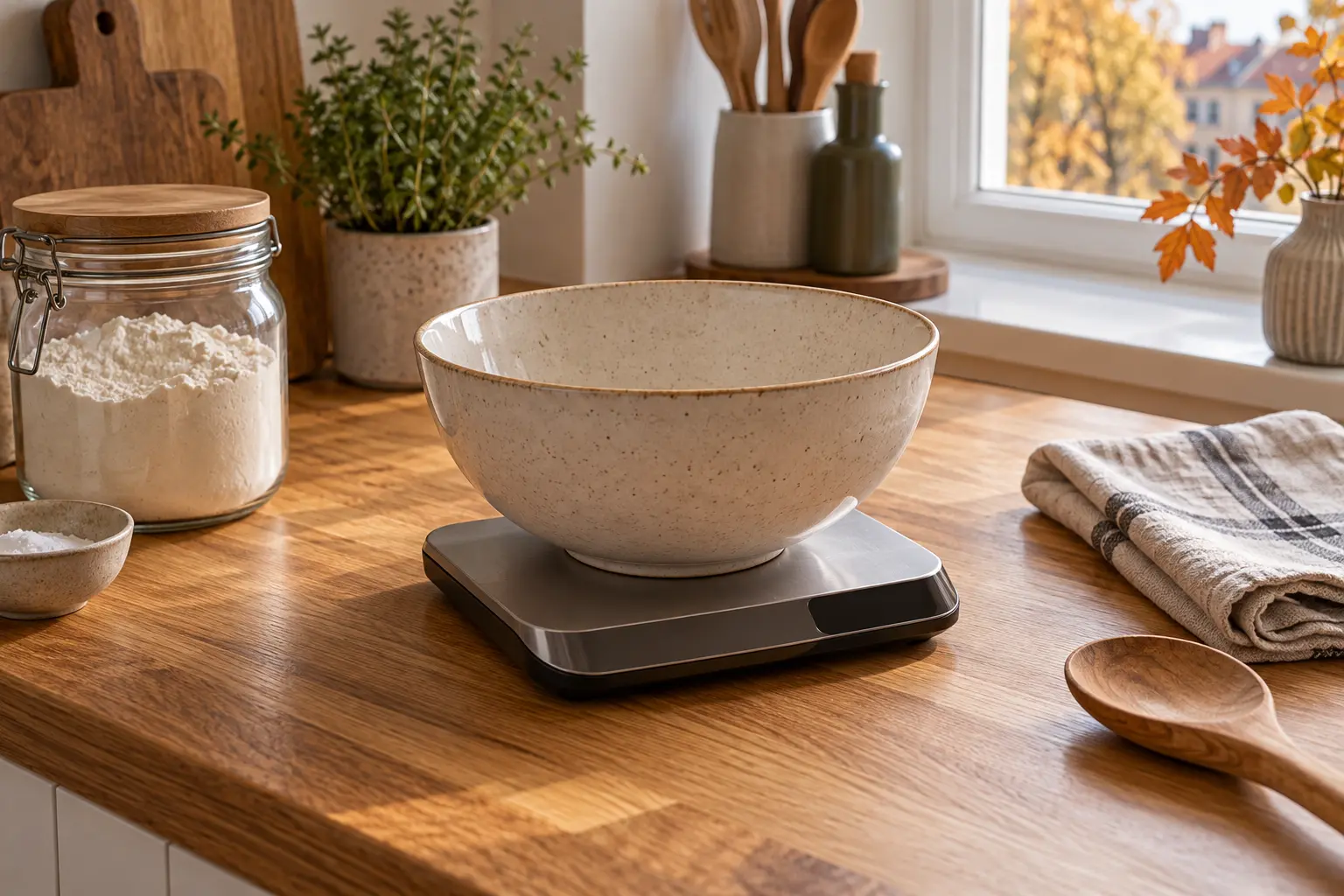
Autumn baking is a pleasant reason to bring out kitchen equipment. A second-hand digital scale can be useful, but an illuminated display does not prove that it is convenient or working properly. A short check before paying helps separate demonstrated functions from unanswered questions.
Identify the model first
Ask for a photograph of the underside label and find the manual for that exact model. Check maximum load, display increments, power supply and available units. A one-gram display increment does not promise accuracy to one gram.
Try the bowl you expect to use: does it fit, and can you still see the screen? The container is part of the total load. Using tare does not provide unlimited capacity; follow the manual.
Test it on a steady surface
Set the scale on a firm, level surface, switch it on and wait for zero. Place one dry object on it, note the reading, remove it and repeat several times. Check that it returns to zero without changing the surface or moving the scale.
Clearly fluctuating readings need investigation. This checks repeatability, not calibration. A packet labelled “1 kg” is not a certified test weight, and deliberately overloading the scale can damage it.
Check tare and units
Put an empty bowl on the platform and zero it with the proper control, then add a small dry object. Check that the display is readable, the buttons respond and the intended mass unit is selected. Operating sequences vary by model.
If there is a millilitre mode, read which liquids it is intended for. It is not a universal volume measurement for every ingredient. Also check automatic switch-off timing so a pause in a recipe does not cause a surprise.
Inspect condition and cleaning needs
Look at the feet, platform, battery cover and accessible contacts. Cracks, leakage or a missing cover are reasons not to use the scale until the issue is assessed and resolved. Keep small batteries away from children.
Check cleaning instructions in advance. A glass platform does not make the electronics waterproof. Follow the manual, do not immerse the casing, and include batteries or missing parts in the total cost.
Before buying
- Model and maximum load are known.
- The display remains visible with your bowl.
- Zero, tare and required units have been tested.
- Repeat readings do not raise concerns.
- Casing, feet and battery cover are intact.
If the seller cannot demonstrate the scale, treat its operation as unverified rather than assumed. A helpful listing describes the checks performed instead of promising laboratory precision.