

















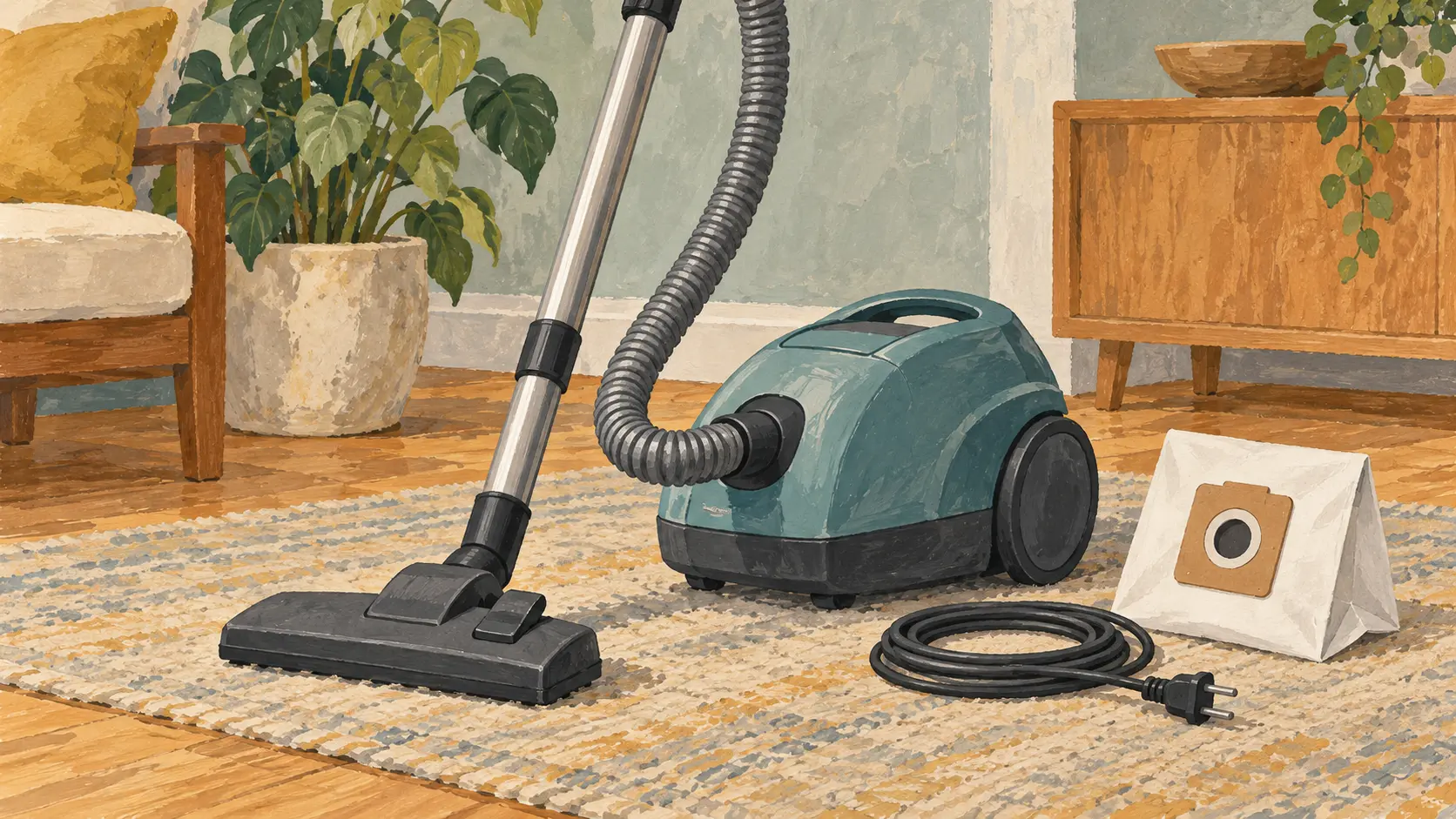
After a wet autumn walk, hallway dirt makes a practical vacuum more interesting than an impressive specification. If you are considering a used corded, bagged cleaner, check the complete route from floor head to dust bag before agreeing a price. This guide does not cover wet cleaners, robot vacuums or battery life.
Identify the cleaner and the floor head
Request a clear photograph of the model label and a separate picture of everything included. Match the exact model to its manufacturer manual. Check whether the supplied head is suitable for your floor, rather than assuming that a brush which attaches is appropriate for delicate wood or a particular carpet.
Ask about previous use, repairs and known faults. Has it been used for ordinary household dirt or renovation debris? Treat the answer as the seller's account, not proof of the machine's internal condition. Confirm where you will keep the cleaner and whether the hose and tube can be stored without sharp bends.
Inspect before plugging in
With the cleaner disconnected, look at the whole cable, plug, casing and connectors. Crushed insulation, exposed conductors, scorching or suspicious repairs are reasons not to switch it on. Leave electrical assessment to a qualified specialist; do not open the motor enclosure to investigate a bargain.
Estonia's TTJA guidance requires equipment to be safe and technically sound. A motor that starts is not an electrical safety certificate. Stop the purchase test if safety is uncertain, even if the seller offers a quick demonstration.
Follow the hose and fittings
Inspect the flexible hose along its length, especially near the handles and connectors. Look for splits, taped repairs and loose catches. Check that the telescopic tube adjusts and holds at a normal working length. Wheels should turn and the floor head should move as designed without forcing anything.
Ask to see the dust compartment only as the manual permits, with the machine unplugged. Look at the bag seating, accessible seals and closure. Do not bypass an interlock or force a lid shut. Cosmetic scuffs on the outside are different from a broken latch that prevents proper assembly.
Find the consumables before paying
Identify the exact bag and filter references, then check compatible supply and cost in Estonia. A nearly full box of the wrong bags does not complete the set. Ask when the fitted bag and filters were last changed; a clean casing tells you nothing about that history.
Miele's support information explains that full bags or clogged filters can reduce suction. That does not establish the cause of weak performance in the cleaner you are buying. Do not accept “only needs a filter” as a confirmed diagnosis or wash a filter unless its own instructions allow it.
Arrange an ordinary, limited demonstration
Only if there are no safety concerns, have the owner demonstrate normal cleaning according to the manual, with the correct bag and filters fitted. Use a suitable dry floor area. Do not introduce liquids, ash, building dust or improvised test material. Check the switch, ordinary adjustment controls and the included head.
Stop if there is a burning smell, unusual noise or other concerning behaviour. Do not keep running it to see whether the problem clears. A short demonstration records what happened under those conditions; it cannot establish remaining motor life, filtration performance or freedom from hidden defects.
Before agreeing the deal
- Model, manual and included accessories match.
- No unresolved safety concern prevents a demonstration.
- Hose, tube, head, seals and closures have been inspected.
- Correct bags and filters are identified and obtainable.
- Necessary parts, cleaning and collection are included in the total.
Record any function that was not shown. An honestly described, complete cleaner may be more useful than a cheaper machine whose essential part or fault remains unexplained.