

















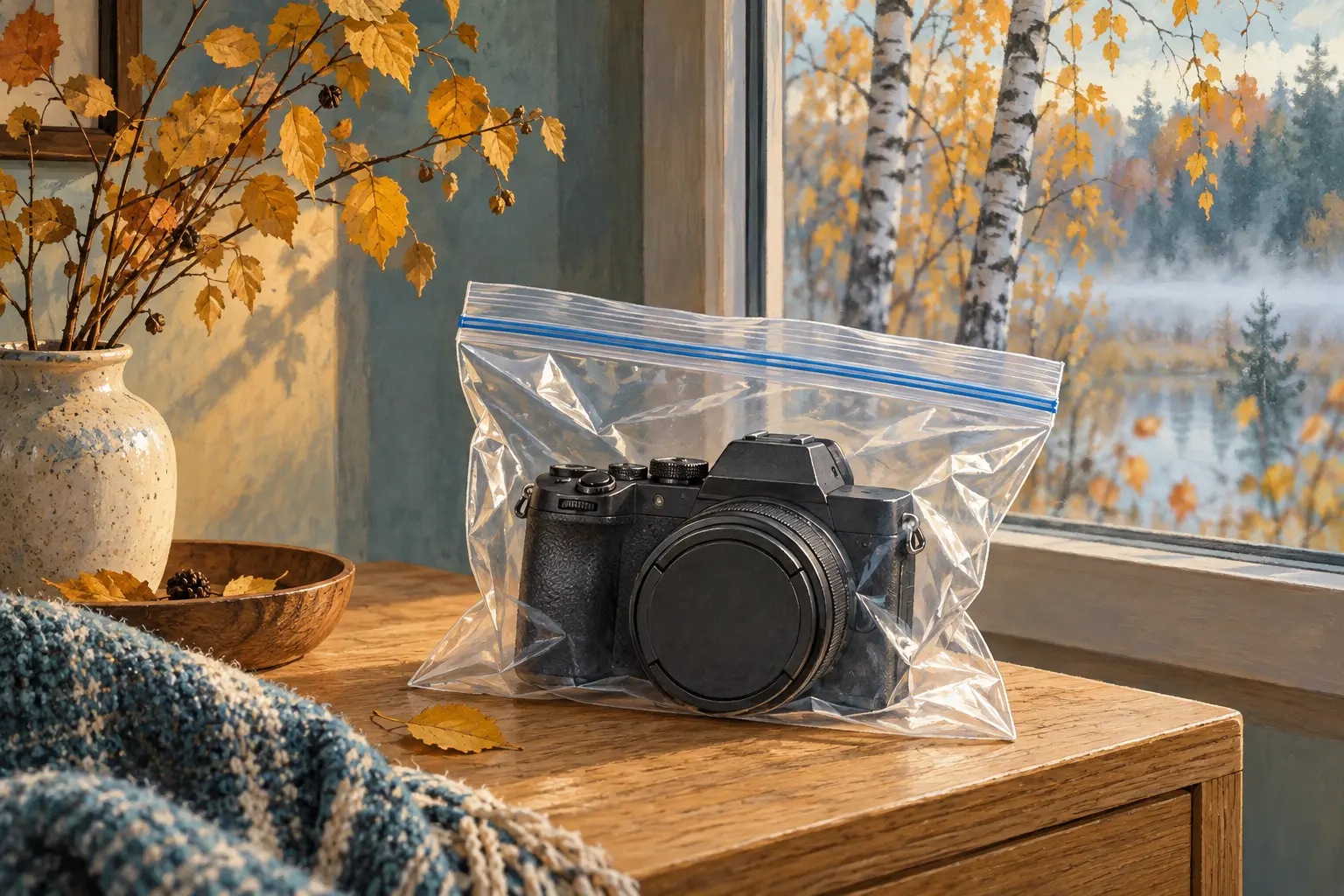
A camera brought indoors after an autumn walk may need a pause before its next photograph. The same applies when a seller arrives with a lens from a cold car. Allow time for the equipment to settle instead of judging it through a hurried doorway demonstration. This simple change makes both care and a second-hand inspection more useful.
Plan the transition before opening the bag
Check the precautions for the exact camera and lens. Sony’s ILCE-7C guide describes a sealed plastic bag during a cold-to-warm transition, followed by acclimatisation. This is a temporary procedure, not advice to store damp equipment in plastic. Prepare any recommended protection before entering the warm space. Keep the instructions available on your phone and make the transition part of the outing, rather than improvising after the glass has misted over.
If the lens fogs, stop the demonstration
Switch the camera off and allow the condensation to clear in accordance with its instructions. Do not use a radiator, hairdryer or direct sunlight to hurry it. A waiting time mentioned in one manual is not a guarantee for every temperature difference or lens. If you are meeting a seller, agree that the inspection can resume later. An incomplete test should remain incomplete, not become an assumed pass because someone needs to leave.
Separate what you see from what you know
Once the equipment has acclimatised, look at the accessible glass and barrel in ordinary good light. Photograph any mark that concerns you and describe its location. A cloudy appearance alone does not tell a buyer whether the cause is moisture, a surface smear or an internal problem. Nikon notes that established fungus can require more than cleaning. Avoid diagnosing it from a listing photo or accepting a seller’s confident explanation as a repair assessment.
Make a useful test, not just a shutter click
Ask to try the lens on a compatible camera, with permission, after the equipment is ready. Use an ordinary detailed subject and examine the saved pictures, not only the rear-screen preview. Try the functions you intend to use, following the manual: focusing, zooming and relevant switches. Record what was actually tested. One sharp picture does not establish every function, while an unfamiliar setting can also confuse the result. Resolve uncertainty before agreeing a price.
Ask about the time between outings
Storage history deserves a specific question: where was the lens kept, was it put away damp, and has it been serviced? A tidy carrying case is not evidence of suitable storage conditions. Request any service record and distinguish a seller’s recollection from documented work. For your own equipment, follow the maker’s drying and storage advice after use. Do not treat a short acclimatisation routine as a substitute for checking that the bag and equipment are ready for longer storage.
Know when to leave the decision open
Persistent internal marks, unexplained haze or functions that cannot be tested are reasons to pause. A professional assessment may be more useful than a discount based on guesswork. Ask for a repair estimate before assuming the problem is economical to fix; no home cleaning recipe can promise that. A seller can help by supplying the exact model, mount, known faults and clear glass photographs, with unedited sample images where available.
Before agreeing to buy
- Allow time after the cold-to-warm move.
- Check the exact model and camera compatibility.
- Describe marks without inventing a diagnosis.
- Inspect saved test photographs with permission.
- Resolve persistent haze or unknown repair needs.
On Zeppik, a precise description of storage and observed condition is more valuable than “perfect optics”. If the lens remains uncertain after a calm inspection, you can postpone or decline the purchase. Keeping a useful existing lens dry and properly stored is also a good outcome; autumn does not create a need to replace it.