














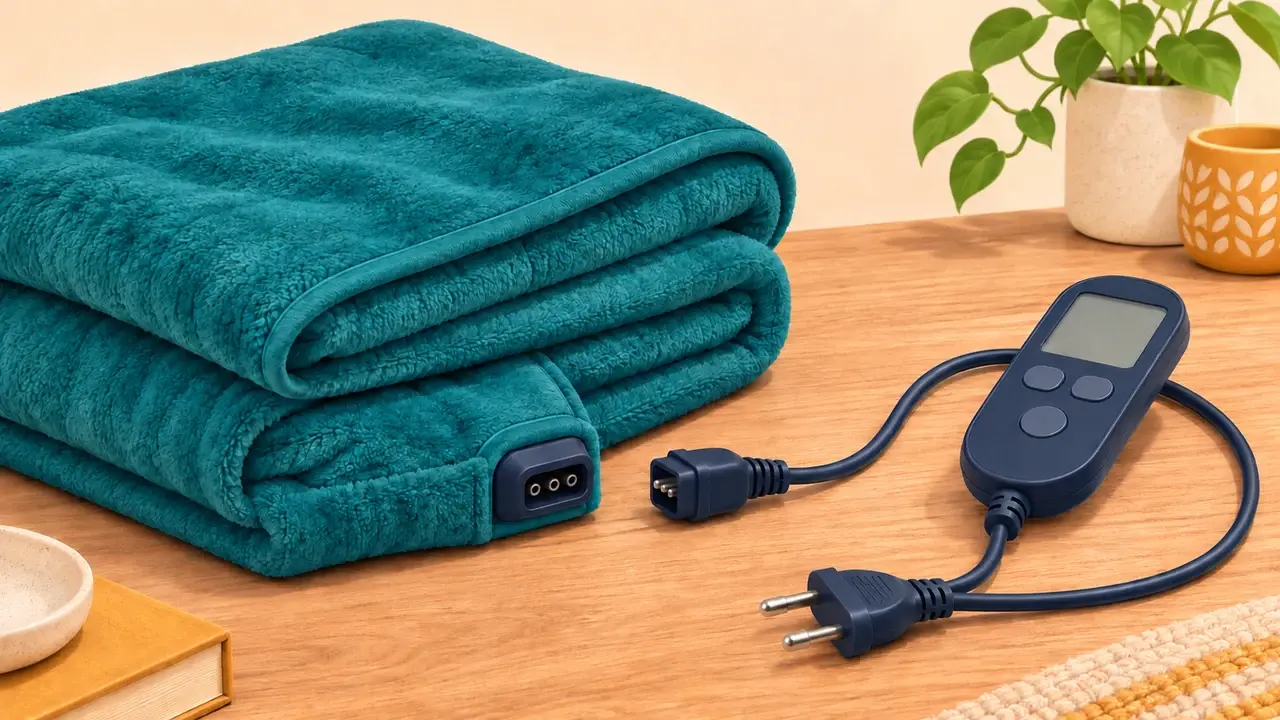
A soft, clean-looking heated throw can arrive without its box or paperwork. Before washing or trying it, establish exactly what you have. London Fire Brigade advises against buying second-hand electric blankets. The checks below help organise questions about an item already received; they cannot certify it as safe.
Identify both parts of the set
Photograph the throw’s label and the controller’s markings while everything is unplugged. Write down the maker, model and product number. Do not treat a similar connector, colour or brand name as proof that two parts belong together. Ask the previous owner whether the controller came with this particular throw or was added later.
Find the manufacturer’s manual matching the product identification. A seller’s screenshot for a similar blanket is not enough. Keep the manual with both label photographs so that support can see the actual combination if you need advice.
Confirm the controller, not just the plug
The Beurer HD 75 manual requires its specified controller and forbids wet use or powering the throw to dry it.
That model is an example, not a compatibility list for other products. Use only the original or manufacturer-confirmed controller for the exact item. Do not try a homemade controller or adapter. If identification remains uncertain, leave the set unplugged and ask the manufacturer to resolve it.
Decide whether cleaning is permitted
Not every electrically heated textile is washable. Read the actual model’s cleaning section before taking anything apart. List the permitted method, drying instructions and conditions for reconnecting. Do not borrow a programme from an ordinary fleece blanket or another heated product.
Beurer’s cleaning guidance says to unplug, detach the controller, keep it dry and reconnect only after complete drying. The model’s instructions govern the details.
Keep uncertainty visible
- Record where the throw came from and what history is known.
- Note missing paperwork, replaced parts and previous cleaning.
- Save the manufacturer’s answer before making a decision.
Scorch marks or damaged cables are reasons to stop, not to arrange a quick powered demonstration. A neat exterior and a matching label cannot reveal every internal fault. If safety remains in doubt, do not use the throw or pass it on as a working product.
For a replacement, prefer a new product from an identifiable retailer with its documentation. Washing does not establish safety; ask the manufacturer about qualified inspection if the history is uncertain.