

















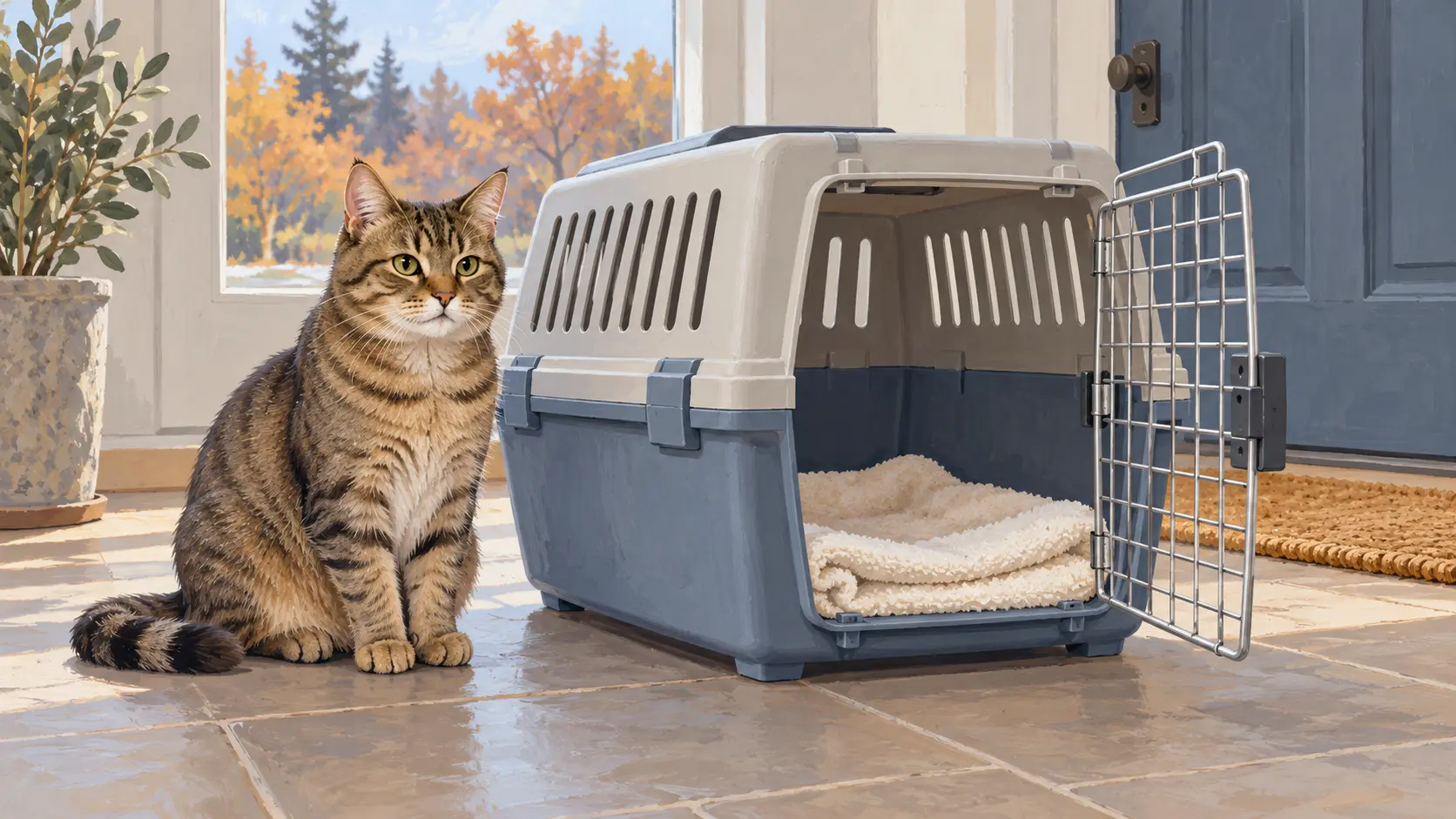
A veterinary appointment or house move may mean travelling with your cat when the weather turns colder. If you are considering a used carrier, focus on its structure, fit and cleaning rather than its colour or an attractive price. A neat photograph cannot show whether every fastening works. Inspect the carrier empty and keep your cat safely at home during the buying appointment.
Start with your cat, not the outside measurements
Ask for the usable internal dimensions, door opening and the manufacturer's stated weight limit for the exact model. Exterior measurements include walls and fittings, so they may overstate the space available. Allow for the bedding you intend to use without filling the carrier with bulky padding.
Cats Protection recommends a secure, cleanable carrier with room for comfortable repositioning. Check practical fit against your own cat rather than a seller's description such as suitable for all cats. A photograph of another animal is not a size guarantee.
Inspect the shell and every joining point
For a hard carrier, look closely at the base, corners, handle mounts and the join between upper and lower sections. Ask the seller to show how the carrier comes apart, if its design allows this. Count all clips, screws or other fasteners against the manufacturer's instructions rather than assuming a spare-looking hole is unimportant.
Cracks, a distorted frame, sharp edges, missing fasteners or a handle that is separating are reasons not to treat it as travel-ready. Do not accept tape, string or improvised cable ties as a substitute for the specified fittings. A replacement part only belongs in your cost calculation after its compatibility and availability are confirmed.
Test doors and locks while empty
Open and close each entrance several times. Check that the door sits correctly and every latch reaches its intended closed position. On a zipped carrier, examine the zip along its whole path, the mesh, seams and attachment points. A damaged fastening is not merely cosmetic.
Ask the seller to demonstrate the correct assembly, then repeat it yourself without forcing anything. If it is difficult to tell whether a latch is fully engaged, stop and consult the instructions. A simple inspection does not certify crash protection, and a carry handle does not automatically double as a vehicle restraint point.
Decide how it can be cleaned
Look into corners, seams and under any removable liner. Ask about previous animals, storage, accidents and cleaning products used. A strong perfume can make the underlying condition harder to judge; it is not evidence of cleanliness. Check whether the liner can be removed and whether the base has hidden damage.
Follow the carrier manufacturer's cleaning directions for the actual materials, and let everything dry fully before use. If there is an uncertain infection history or a cleaning question that affects your cat's health, ask your veterinary practice rather than inventing a disinfectant mixture. A persistently dirty or damaged carrier may be the wrong purchase even at a low price.
Prepare for a necessary cold-weather trip
Battersea recommends familiar bedding and gradual, voluntary introduction to the carrier. Give yourself time before the appointment instead of first presenting the carrier at the front door. Begin at home with access open and follow your cat's pace; a new-to-you carrier needs familiarisation too.
Use suitable bedding without blocking ventilation. Do not wrap the carrier airtight for warmth or place it against a direct heater. Plan how it will be positioned and secured during transport using the carrier and vehicle instructions. The seller's claim that it fits a car, train or airline is not confirmation of your particular journey's requirements.
A checklist to take to the meeting
- Exact model, internal dimensions and weight limit identified.
- Space assessed for your cat with practical bedding.
- Shell, base, handle and all joining points inspected.
- Every door, clip, screw or zip checked while empty.
- No improvised substitute for a missing structural part.
- Cleaning method and replacement-part costs understood.
- Time allowed for drying and familiarisation before travel.
In a Zeppik listing, show the carrier open and closed, photograph fastenings and disclose damage. For buyers, a reliable closure and appropriate fit matter more than saving a small amount on something that still needs an uncertain repair.