


















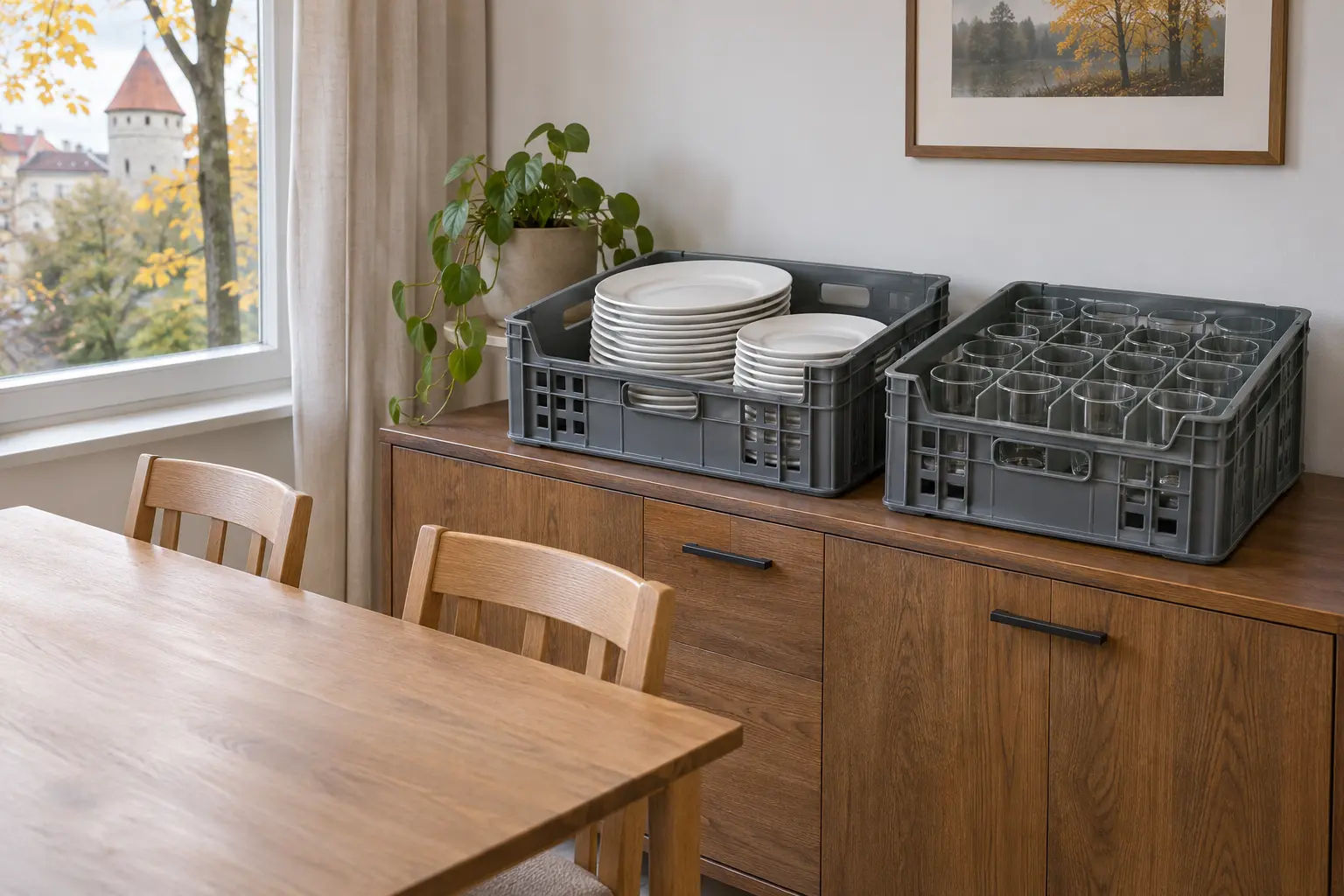
A family gathering can require more plates and glasses than an ordinary kitchen holds. Buying a large set for one afternoon creates a storage problem afterwards. Renting can be a practical alternative, but a basket of attractive plates is not yet a workable order. The important questions are what will be served, how the items reach the table and who returns them in the agreed condition.
The cover is an AI-generated illustration, not a specific rental set or a transport-packing instruction.
Build the list around the meal
Start with the confirmed number of guests and the way food will be served. A seated meal, a buffet and coffee with cake need different items. Write out each stage, including serving dishes and utensils, rather than multiplying one plate by the guest count. Check which items you already have and whether they fit the intended use.
For example, a small soup-and-cake gathering may need bowls, spoons, cake plates, forks and cups, not only dinner plates. This is a planning example, not a standard rental bundle. Discuss a sensible spare quantity with the supplier. Ask about plate dimensions and tray sizes where table or transport space is tight; a photograph does not establish whether a set will fit.
Book the whole journey
Give the supplier the event date, required collection time and realistic return time. Name the person responsible for returning the crates before the celebration begins. Check whether weekend handover requires a separate arrangement. A website’s catalogue does not prove that the same series is available in the quantity you need on your date.
Rendinõud’s own guide describes orders by private customers and either collection or delivery. Its timing and charging arrangements are that operator’s conditions, not a nationwide rule. Obtain confirmation of your actual dates, delivery location and rental period. If the venue must be emptied that evening, include somewhere appropriate to hold the packed items until the agreed handover.
Check the full cost and washing instructions
Ask for a total including tax, transport, any security deposit and the washing options for your selected items. Check cancellation terms and the charge for missing or broken pieces before confirming. A security deposit is not the rental price, and it does not automatically remove responsibility for damage. Do not assume that unused reserved items can simply be excluded from the bill.
Washing is particularly item-specific. Rendinõud states that ordinary tableware washing is included, while the customer returns it rinsed and free of food residue; some equipment and larger serving items have a separate washing choice. Reserv Rent requires food and drink remnants to be removed and items sorted into their original packaging. Read the instructions for your exact order instead of turning either example into a universal rule. Ask separately about textiles or equipment rather than treating them like plates.
Count at collection, organise at the venue
Compare quantities and condition with the handover list before use. Report missing or damaged items promptly and agree how they are recorded. Keep the original crates and dividers together; do not throw them away as packaging waste. Confirm how the load should be secured for transport and choose a vehicle with enough room rather than forcing glassware into loose bags.
At the gathering, keep rented pieces distinguishable from the household’s dishes. Set aside a clear collection area so a guest helping with the washing does not unknowingly mix sets or discard containers. Afterwards, count by item type, follow the agreed preparation instructions and disclose breakage instead of hiding it in a full crate. Check the returned quantities and any remaining balance with the supplier. The rental is finished when the handover is reconciled, not merely when the last guest leaves.