

















A few hours between arrival and your next appointment can be useful, unless you spend them carrying a suitcase. Luggage storage can free your hands for errands in Tallinn, but the important decision is not simply where to leave the bag. Plan how and when you will collect it before paying. This concerns temporary storage, not shipping a parcel or checking luggage onto a flight.
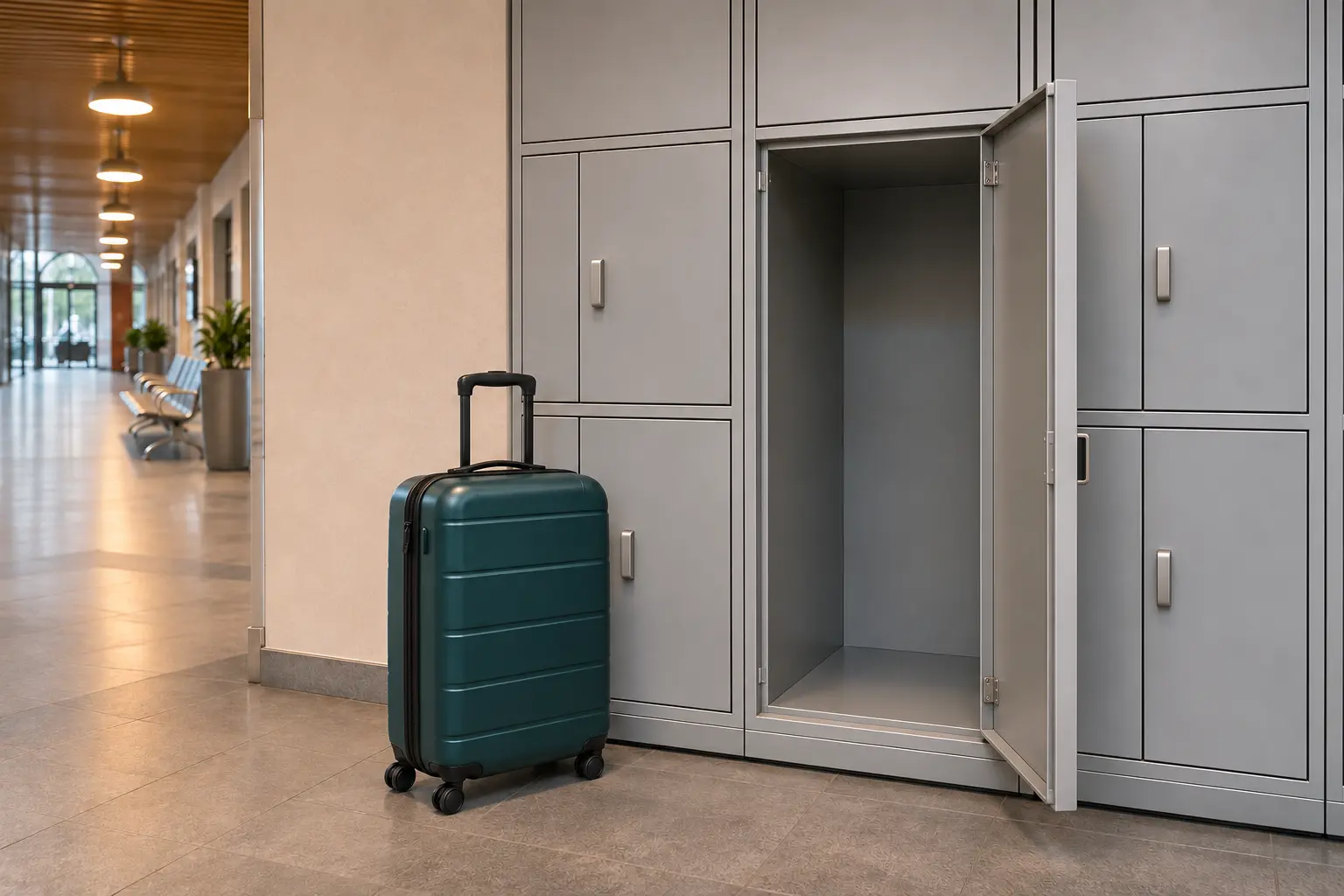
The cover was created with AI as an illustration and does not depict a specific luggage-storage facility or operator.
Choose the facility around the return journey
Start with your next departure point and the latest sensible collection time. Add the journey back to storage, the time needed to retrieve the bag and a margin for finding the correct platform or check-in desk. A cheap locker across the city may make a short errand unnecessarily complicated.
Tallinn Airport’s official page places its storage lockers on level 0 of the passenger terminal and lists them as always open. Tallinn Bus Station describes lockers downstairs, to the left after entering through the main entrance. It separately lists Cargobus luggage storage in the western wing, including an option for larger items. These are distinct facilities: the airport’s access information does not apply to the bus station or a staffed counter.
Check the current opening and collection arrangements for the exact service and day. A building can remain open while a staffed luggage service is closed. If stairs or lifting are a problem, confirm the usable route or available assistance before bringing a heavy bag. Do not infer step-free access from the station’s general address.
Measure the packed bag, not its label
Record the bag’s actual height, width and depth, including wheels, fixed handles and bulging pockets. Compare all three measurements with the current compartment information. The airport offers several sizes; the bus station also publishes a maximum size for its lockers. A bag described as cabin luggage is not automatically suitable for every storage compartment.
Check available space before committing to a particular arrangement. Do not force a door against a suitcase or leave a strap trapped in the seal. If the bag does not fit, ask about a larger compartment or a staffed alternative. A listed service is not a guarantee that a suitable locker will be empty when you arrive.
Understand payment and access together
Read the displayed tariff, charging period and late-collection terms. A price for a day does not by itself explain when the paid period ends or what happens if you return late. The airport currently lists bank and card payment and additional charges for exceeding the storage period. Do not assume the bus station uses the same payment method, or rely on an old report about coins.
Check whether opening the compartment ends the storage session and whether intermediate access is allowed. The airport describes a limited initial period for repeated opening after payment; that is not a promise of unrestricted access throughout the booking. Follow the current on-site instructions before leaving.
Keep the means of collection with you
Take out your travel documents, phone, essential medication and anything needed for the next part of the day before closing the bag. Read restrictions on stored contents and valuables. Keep the key, access code or collection receipt separate from the stored bag, and do not publish a usable code in a photo. Note the facility and compartment number privately.
Before walking away, verify that the correct door is secured and that payment or handover has been confirmed. Set a reminder for when you must start the return journey, not merely for the departure time. If a key disappears or a door fails to open, use the operator’s posted help contact and provide your booking or receipt details. Do not force the lock or try to open another compartment. Storage is useful only when the retrieval plan works too.