


















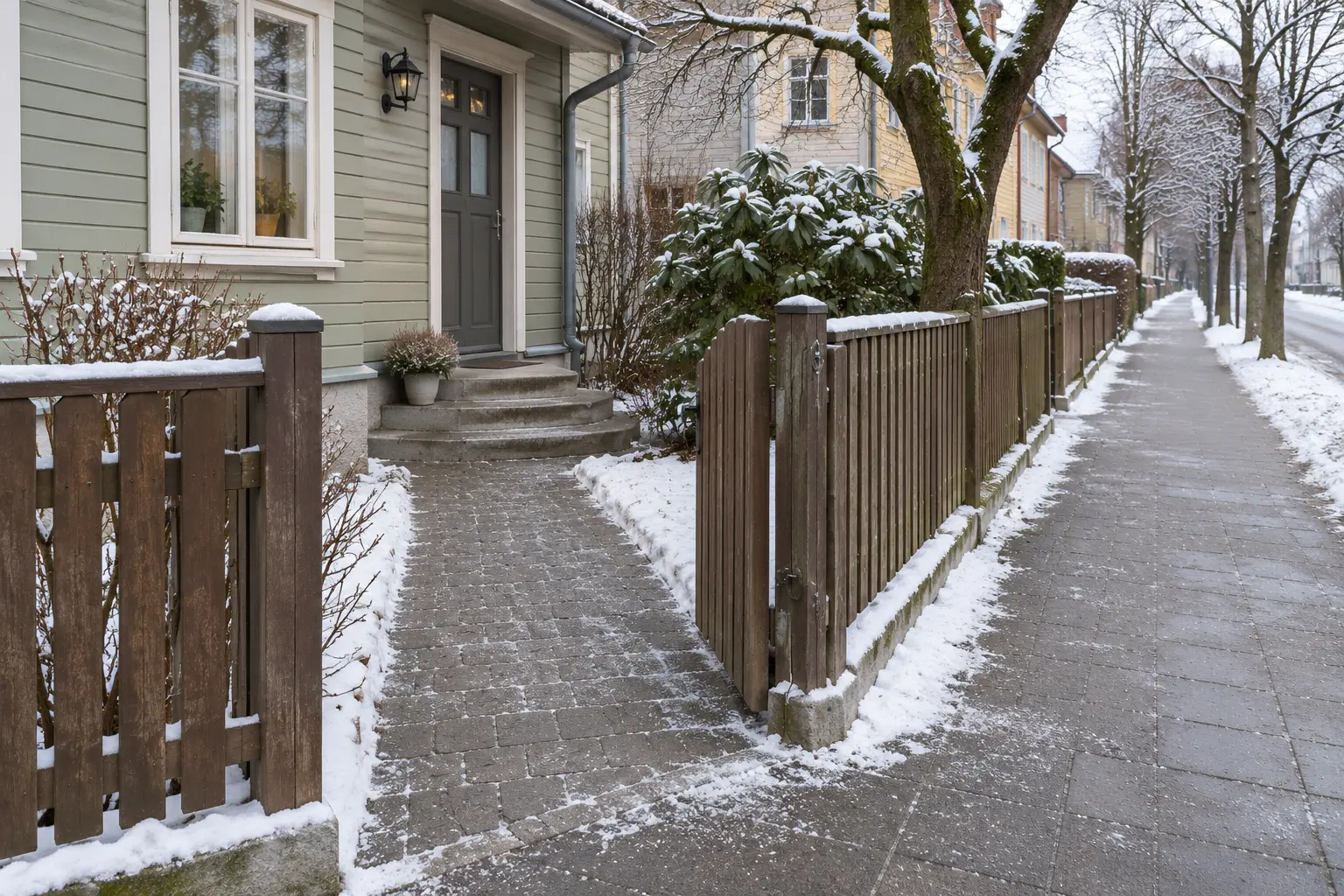
An old notice telling every Tallinn property owner to clear the pavement outside their fence can now lead to the wrong work order. Changes effective from 1 October 2025 shifted specified winter maintenance on city-owned adjoining pavements to Tallinn. That does not mean the city clears every private entrance, courtyard or roof. Before buying a seasonal service, identify the actual area and separate different jobs.
The AI-generated cover depicts a fictional location, not an official map of ownership or maintenance responsibilities.
Draw the route, not just the address
Start with the route from the public pavement to the front door. Mark the adjoining pavement, gate, private path, entrance steps and any shared courtyard separately. Ask the owner or apartment association to confirm the boundary and maintenance arrangement. If the ownership or responsibility of the pavement is unclear, ask the district administration rather than deciding from the position of a fence.
Tallinn's current upkeep rules exempt owners from snow and ice clearance, anti-slip work and removal of the associated grit residue on the city-owned adjoining cleaning area. Other upkeep obligations are not all cancelled. A privately owned adjoining pavement is not automatically included in that exemption. The rules also leave owners responsible for keeping their own property in order and addressing dangerous snow and ice on buildings.
Check what an old contract actually covers
Read the existing caretaker or clearance agreement before commissioning another visit. Does it cover private access routes, an adjoining pavement, roof work or several of these? Ask the association or manager to review the defined areas against the current arrangement. Do not cancel a whole service merely because one part of the pavement is now city-maintained.
For remaining private work, make a simple marked plan and agree what a completed visit means. Include entrances people actually use, not only the most visible strip. Clarify who checks conditions after fresh snow or refreezing, who receives reports and what happens when the usual worker is away. A single morning visit cannot be assumed to solve every changing condition throughout winter.
Decide where the snow will go
Discuss storage or removal before a large pile exists. A convenient heap can obstruct a gate, obscure an exit or block somebody else's passage. Tallinn's rules prohibit piling snow onto the carriageway and leaving snow or ice dropped from a roof on the pavement or carriageway. Do not treat a city-cleared route as a place to push snow from your private path.
Ask the contractor to use suitable, permitted anti-slip materials for the specific surface. The rules restrict ash and chlorides on pedestrian and cycle routes, with a limited written-permission exception for chlorides in severe weather. Do not improvise a chemical mixture or assume any shop-bought de-icer is authorised everywhere. Material selection and later residue removal should be clear in the agreement.
Keep roof danger a separate task
City pavement maintenance does not remove the building owner's duty to address dangerous roof snow or icicles. Report a suspected danger to the responsible owner or manager and arrange competent help. Do not climb onto a roof, stand beneath hanging ice or try to knock it down over pedestrians. Temporary warning arrangements do not replace removing the danger; the responsible party must organise safe passage and the required notifications.
Report the exact unresolved location
For a city-maintained route, use Tallinn's current winter-maintenance information and reporting channel. Give the address, which side of the street, the specific section and when you saw the problem. A photograph taken from a safe place can explain a blocked crossing or slippery stretch better than “our street is bad”. For private access, contact the agreed manager or contractor. Keep the reply with the area plan so the next snowfall does not restart the same argument about who does what.