


















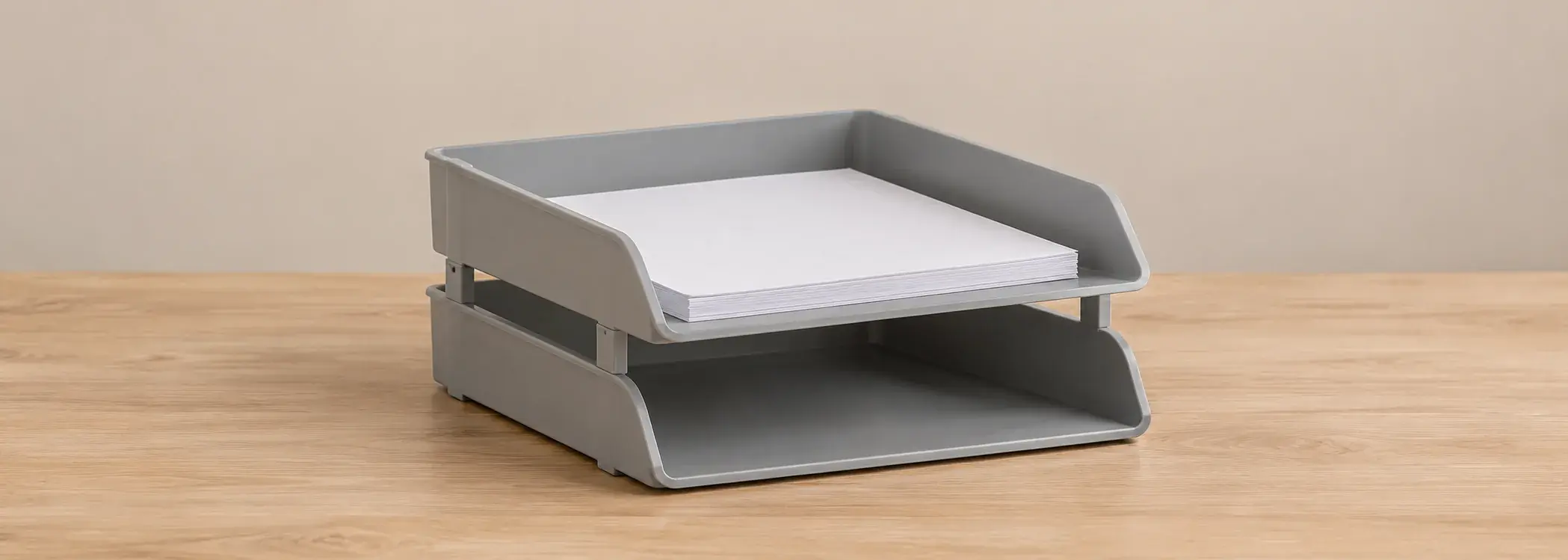
A bundle of used letter trays can look like an easy way to organise a desk. The useful question is whether the trays accept your papers and work together as a stable set. These are open desktop trays, not document folders: the paper needs enough flat support and enough space to be lifted out without crumpling its corners.
Test the inside, not the outside
Ask for the clear internal width and depth as well as the overall footprint. Raised ribs, curved sides and a rear stop can reduce the usable area. A4 paper measures 210 by 297 millimetres, but a tray with those outside dimensions would not necessarily hold it. A sleeve or envelope may need more room than the sheet inside it.
With the seller's permission, place a clean A4 sheet flat on the base. It should not need folding, curling or pushing underneath a ledge. Then try the type of document you normally handle, without using private paperwork for the demonstration. Check whether you can grasp the front edge easily. A broad opening can matter more in daily use than a decorative label holder.
Stack the actual pieces
Ask for the maker and model markings on every tray, especially when a set contains different colours or heights. Similar outlines do not prove compatibility. Esselte describes vertical and stepped stacking for its Europost VIVIDA tray. This shows that stacking positions can be designed features; it does not mean every office tray can be offset safely.
Place the offered pieces together on a level desk in their intended arrangement. Inspect the feet, ledges and locating points. Check that each tray sits in its proper position rather than balancing on a rim. Do not force a mismatched set together or build a tall tower as a strength test. Any spacers shown in the advertisement should be counted and identified.
Look underneath before deciding
Inspect the bottom and corners for cracks, stressed pale patches in plastic and repairs. On metal trays, look for bent mesh, projecting wire and damaged edges that could catch paper. A surface scratch is different from a split at a load-bearing corner. Ask whether old labels can remain rather than assuming strong solvent is safe for the finish.
Finally, measure the assembled height and the depth of any stepped arrangement on your own desk. Leave room for your hand between levels and keep the stack away from the edge. A useful listing states the number of trays, verified model names, measured space and known damage. Describe the paper-fit and stacking check you performed, without promising that untested extra trays will fit.