













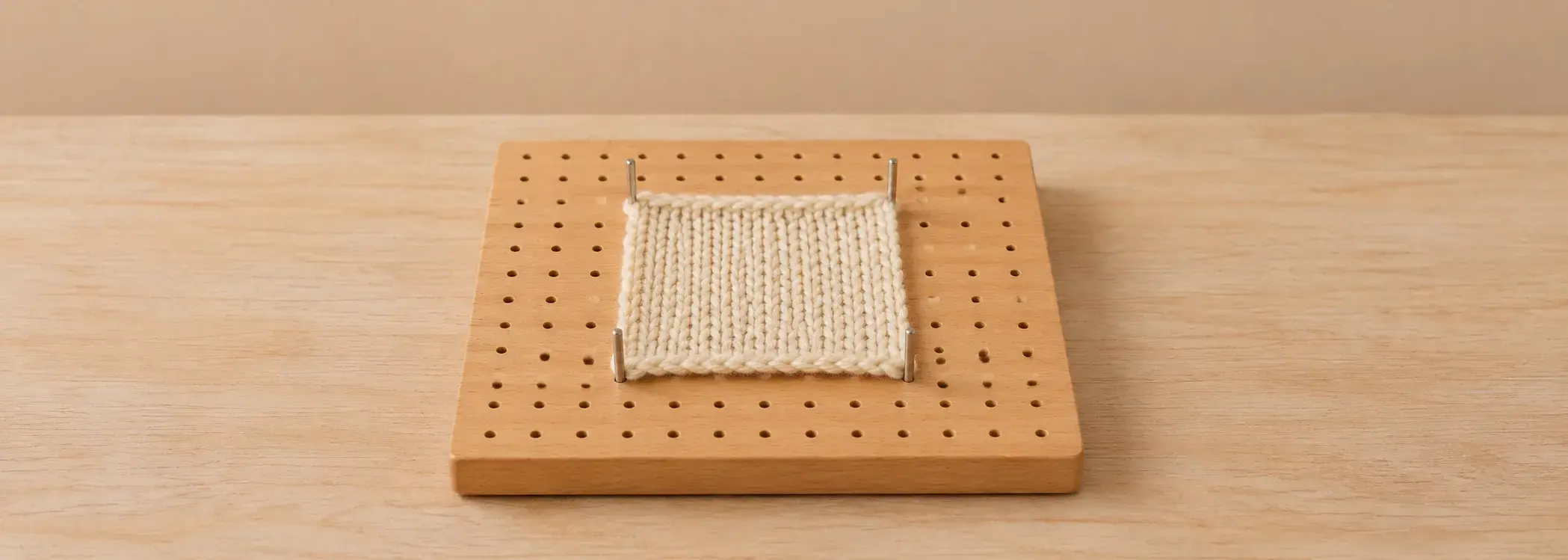
A crochet blocking board shapes finished motifs while they dry; it is not a substitute for choosing the right crochet hook. When buying one second-hand, the useful question is whether its holes and pegs can support the sizes you actually make. A large wooden rectangle can still offer an unsuitable pattern of fixing points.
Measure the working area
Ask for a photograph taken straight above the empty board, with a ruler beside the holes. Measure the distance between the fixing positions you would use, not only the outside edges. Check the spacing in both directions. If you regularly make a particular square, compare its intended finished size with the available positions before arranging collection.
Do not assume that the nearest set of holes will give the exact measurement in your pattern. Nor should you stretch a motif aggressively just to fit a board. Blocking choices also depend on the yarn and its care instructions. The board helps hold an arrangement; it does not guarantee identical results from every fibre or stitch pattern.
Test the pegs as a set
Count the pegs included and ask whether any are replacements. With permission, fit several into different holes, including positions near the centre and edges. They should engage as intended without hammering or improvised packing. Look for excessive wobble, bent shafts, rough tips, corrosion and sharp burrs that could snag or mark yarn.
Inspect the holes for split edges, heavy wear and residue. A peg that fits one hole does not prove that the entire board is usable. If the set is incomplete, establish the correct replacements before treating a cheap board as good value. Similar-looking metal rods are not automatically compatible or suitable for contact with damp yarn.
Look along the surface
Place the empty board on a level table and check for rocking. View its edge from the side to look for warping, cracks and separating layers. Inspect both faces for rough areas or staining. Ask how it was stored and whether moisture caused any visible change. Photographs alone may not reveal a bowed surface.
Hobbii's wooden-board instructions say that motifs must not be too wet, should dry completely before joining, and should be kept away from direct heat sources with the board. Apply the actual board's instructions and the yarn label rather than assuming all wood tolerates soaking or steam. Store the board dry and protect loose pegs. For resale, list the real peg count, working measurements and defects. These details are more useful than claiming that one board suits every blanket project.